
Major overview
Study automation engineering in a real plant and control room on campus
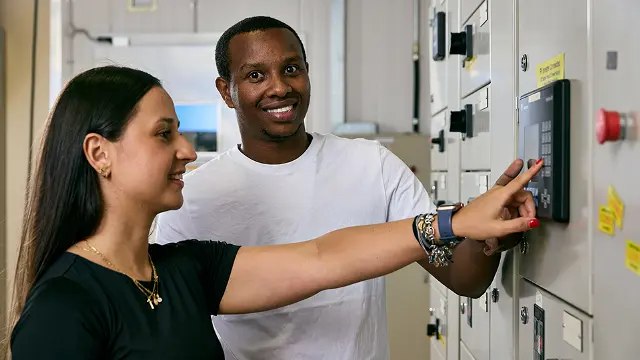
3 reasons to study engineering at Murdoch University
- Learn in a real engineering plant and control room, the only facility of its kind on a WA university campus, and gain hands-on experience with industry-standard systems.
- Complete 300 hours of practical experience, applying your learning to industry projects and building professional connections.
- Five-star rating and #1 university in Australia for overall educational experience, skills development and teaching quality for Engineering and Technology by the Good Universities Guide 2026.
What you’ll learn
- Understand embedded systems, sensors and real-time data communication.
- Design and analyse control systems used in industrial and automated environments.
- Work with programmable logic controllers (PLC), supervisory control and data acquisition (SCADA) and instrumentation systems.
- Apply modelling and systems engineering to optimise performance and reliability.
- Develop solutions for automation across manufacturing, energy and infrastructure systems.
I use what I learned at Murdoch University every day. The field visits taught us how the industry really works – not just the technology, but what employers look for in people.
Rohit Bomma, Master of Renewable and Sustainable Energy
Read full student story


Your future career in engineering
- Control systems technician
- Automation technician
- Instrumentation technician
- Process control specialist
- Automation and systems engineer
Start dates
| Starting period | Location | Face to Face | Online | Mixed mode |
|---|---|---|---|---|
| Semester 1, 2026 | Murdoch | Yes | No | No |
| Semester 2, 2026 | Murdoch | Yes | No | No |
| Semester 1, 2027 | Murdoch | Yes | No | No |
| Semester 2, 2027 | Murdoch | Yes | No | No |
View the dates for our teaching periods or find out more about attendance modes.
Major Structure
Visit the Course Handbook - Get detailed information on units, prerequisites, and pathways.
To help plan the structure of your course, search for our suggested course plans.
| Unit code | Unit name | Credit points |
|---|
How to Apply
Majors are part of a degree and can't be applied on their own. Apply for a related degree first, then choose your major once enrolled.
Bachelor of Engineering Technology
Study a Bachelor of Engineering Technology at Murdoch University and gain hands-on, industry-relevant experience in a real engineering plant. Apply today.