Blog
The engineer who believes renewable energy belongs to everyone
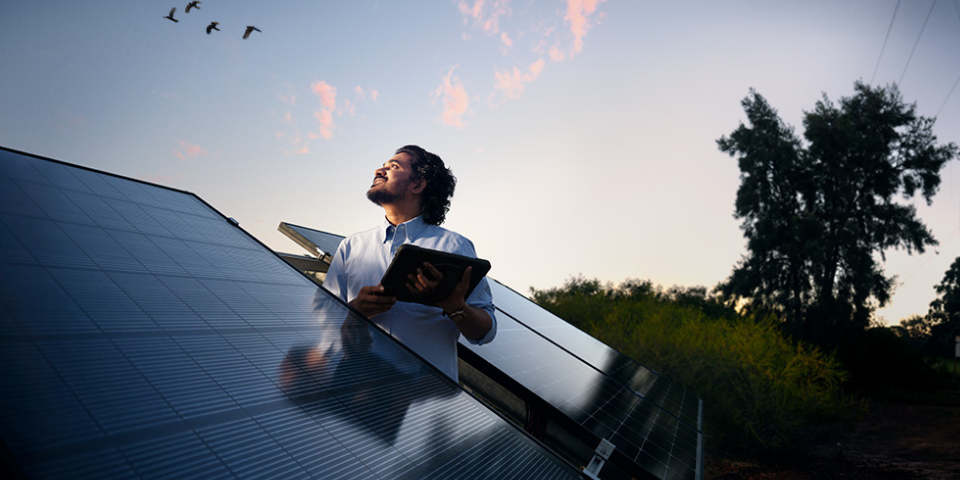
Rohit Bomma wasn't raised surrounded by solar panels. Growing up in Hyderabad, India, power came largely from fossil fuels, and renewable energy was something he encountered on-screen.
"I used to watch documentaries about renewables," he said. "Solar really stayed with me. It felt like free energy – something that should belong to everyone."
That idea took root during his undergraduate degree in electrical engineering, when a university project asked him to think about real time use of electrical systems. Rohit designed a solar‑powered irrigation setup that allowed farmers to control it remotely.
"That was the first time I saw how solar could actually help people," he said. "It wasn't abstract. It was practical, and it mattered."
After graduating, he worked for three years then realised he would need to move beyond Hyderabad for more opportunities to be part of the renewable energy industry.
"I just kept thinking about solar," he said.
Friends encouraged him to move to the United States, but when Rohit looked into study options there, he found few programs focused squarely on renewable energy.
Australia, by contrast, offered something different – and Murdoch University stood out for its dedicated course in renewable and sustainable energy.
"It was the only place that treated renewables as the main discipline, not an add‑on," he said.
The decision was validated almost instantly.
First year, first semester, first day – I walked into the lab and I just knew I'd made the right decision.
"We weren't just learning theory. We were seeing how it worked in the real world."
Murdoch University's emphasis on fieldwork and simulation shaped his confidence as an engineer.
"The software and design tools we used back then are the same ones I use now in industry," he said.
"That preparation made a huge difference."
While solar remained his passion, the course exposed him to wind, tidal energy and sustainable building design.
"It gave me a broad understanding of how all these systems connect, which is important in the real world."
Just as formative was what happened outside the classroom.
Rohit threw himself into volunteering through Murdoch student and sustainability groups, joining beach clean‑ups, tree plantings and river restoration projects.
"Being around people who cared so deeply about the environment changed me."
Those volunteer days became spaces for connection and leadership. Rohit began mentoring others, organising events and eventually co‑founded a student club that invited renewable‑energy professionals to speak on campus.
"It helped me build confidence," he said. "From one‑on‑one conversations to speaking in front of rooms of people, Murdoch University felt like a safe place to learn those skills."
This growing confidence was accompanied by extensive industry exposure, including field trips to engineering companies, infrastructure projects and opportunities to work on real‑world designs.
But the journey wasn't without challenges. When Rohit reached his thesis, momentum stalled.
"Everyone around me was finishing, and I felt stuck," he said. "It was very demotivating and, at that point, I didn't think I would complete my Masters."
"That was when I met Kuruvilla."
Dr Kuruvilla Mathew was one of his lecturers and stepped in to offer his time, encouragement and practical support alongside Dr Martin Anda. Rohit still recalls after-hours meetings with the two academics at their homes to review his thesis and keep on track.
"They were so busy, but they still made time for me. Without them, I wouldn't have finished."
Graduating into a post‑Covid job market brought new challenges, but again the compassion and connections of his lecturers presented opportunities.
Dr Mathew introduced him to solar and batteries company Regen Power, where he began as a site technician and was quickly promoted to electrical engineer, designing systems and managing projects.
"I use what I learned at Murdoch University every day," he said.
The field visits taught us how the industry really works – not just the technology, but what employers look for in people.
Looking back, he also has the deepest gratitude to his parents, sister and friends, who supported his decision to study at Murdoch University and motivated him throughout the journey.
Today, Rohit's work contributes directly to Australia's energy transition, reducing reliance on fossil fuels through solar and battery systems.
"With solar, I know there's a direct benefit to the environment. That's important to me."
Looking back, he is clear about what made the difference.
"Murdoch University wasn't just about education," he said. "It was about people who cared – about students, about the community, about the planet. I'm so thankful for that."
In an era where climate action is essential, Rohit's story is a reminder that transitions are not built on technology alone, but on passion and care – and on the environments that allow people to act on it.
Blog
The engineer who believes renewable energy belongs to everyone
Posted on
Thursday 28 May 2026