
Major overview
Major in physics and apply science to materials, technologies and living systems
Physics is applied, interdisciplinary and connected to the systems that shape our environment and industries. The Physics major within our Bachelor of Science (Physical Sciences) helps you understand the principles of matter, energy, forces and measurement. You’ll develop the skills to apply these principles to areas such as soft matter physics, nanotechnology, functional materials, biophysics and biomaterials – fields that are central to food, agriculture, sustainability, mining, health and emerging technologies.
Throughout your course, you’ll build a strong foundation in core physics, including mechanics, energy, electromagnetism, waves, thermodynamics and modern physics. You will learn how these principles help explain not only the motion of objects or the behaviour of light and electricity, but also how materials bend, flow, conduct, absorb energy, respond to stress and interact with biological systems.
Through laboratory work, modelling and problem-solving, you’ll develop the confidence to move between theory and practice. You will learn to design experiments, analyse data, work with uncertainty, use mathematical and computational tools, and think creatively about interacting physical systems.
This major is suited to students interested in applying physics beyond traditional disciplinary boundaries. You can broaden your expertise by pairing your Physics major with another major in Chemistry, Mathematics and Statistics, Data Science or Information Technology.
You’ll study in a supportive, close-knit environment with approachable academics and have opportunities to learn from staff working across applied and interdisciplinary science.
You’ll graduate with a strong foundation in physics and the analytical, technical and problem-solving skills valued by industry, enabling you to apply physics to practical, emerging and interdisciplinary challenges. You may also choose to complete an Honours year, strengthening your research skills and opening pathways to professional roles, master’s study or doctoral research.
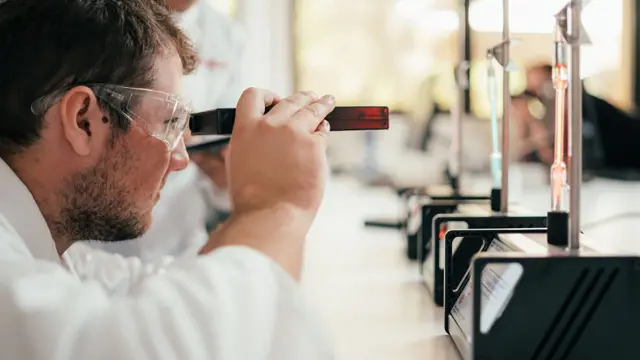
3 reasons to study physics at Murdoch University
- Build practical, transferable skills through hands-on learning, applying physics across science, industry and real-world challenges.
- Learn in small, supportive classes, with opportunities for meaningful interaction with academics and experiences beyond the classroom.
- Learn from academics with international expertise in physics, with teaching informed by research in areas such as critical minerals, agriculture, food technology and medicine.
What you’ll learn
- Build foundational knowledge in core areas such as mechanics, energy, electromagnetism and modern physics.
- Apply physics to tangible systems, from functional materials and nanoscale technologies to biological tissues, sensors and environmental systems.
- Use experimental methods, modelling and computational tools to investigate physical phenomena.
- Develop critical thinking, problem solving, creativity and innovation skills.
- Understand how physics is applied across industries including energy, agriculture, technology and health.
- Communicate scientific concepts clearly to technical and non-technical audiences.
It's applicable to quite literally everything, from business intelligence and marketing reporting to finance and applied sciences - anything to do with biological, medical or veterinary sciences.
Jaiden di Lanzo, Mathematics and Statistics


Your future career in physics
- Applied physicist
- Research scientist
- Technician
- Strategist
- Inventor
- Materials scientist
- Data analyst or scientific modeller
- Environmental, sustainability or energy analyst
- Mining, resources or critical minerals analyst
- Instrumentation, sensors or technical specialist
- Laboratory, testing or measurement scientist
- Medical technology or biophysics-related roles
- Science educator or communicator
Start dates
| Starting period | Location | Face to Face | Online | Mixed mode |
|---|---|---|---|---|
| Semester 1, 2027 | Murdoch | Yes | No | Yes |
| Semester 2, 2027 | Murdoch | Yes | No | Yes |
| Semester 1, 2028 | Murdoch | Yes | No | Yes |
| Semester 2, 2028 | Murdoch | Yes | No | Yes |
View the dates for our teaching periods or find out more about attendance modes.
Major Structure
Visit the Course Handbook - Get detailed information on units, prerequisites, and pathways.
To help plan the structure of your course, search for our suggested course plans.
How to Apply
Majors are part of a degree and can't be applied on their own. Apply for a related degree first, then choose your major once enrolled.
Bachelor of Science (Physical Sciences)
Study a physical sciences degree at Murdoch University and gain hands-on experience in chemistry and physics with real-world applications. Apply now.