
Bachelor of Food Science and Nutrition / Master of Food Science
How to apply
- Entry requirements
- ATAR: 90
more entry options - Study mode
- Part Time Full Time
- Full time duration
- 4
- Murdoch code
- B1427
- First year fee (domestic)
-
2027 $9,953
- Full course fee (domestic)
-
2027 $39,812
- Australian Qualifications Framework level
- Level 9 - Masters Degree (Coursework)
The fees provided are indicative and intended only as a guide. They are based on a typical full-time enrolment for a first year student at Murdoch University of 24 credit points. The indicative fee is based on the applicable domestic fee.
Course overview
Launch your food science career faster with an integrated degree
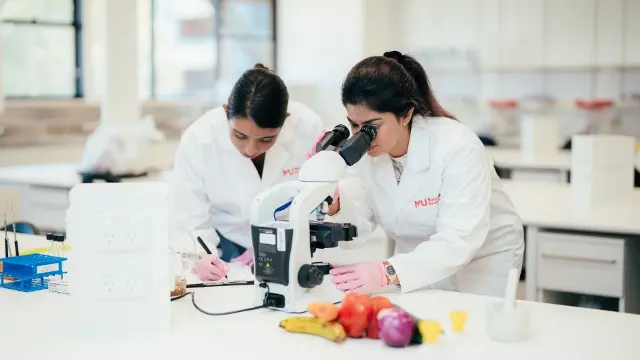
Throughout your food science course, you’ll apply your knowledge through practical learning and research, graduating with both a bachelor’s and master’s qualification and a competitive edge for a career in food science and nutrition.
Learn about student profiles for this course on our Admission Information page.

3 reasons to study food science at Murdoch University
- Fast-track your food science career by combining foundational knowledge from the bachelor’s degree with specialist, practical training at the master’s level in this integrated course.
- Study in industry-connected environments at the Murdoch Health and Knowledge Precinct and the Nambeelup Food Centre, part of FIPWA, using advanced facilities and technologies.
- Build hands-on experience by conducting original research that addresses real-world challenges in food production, safety and quality.
What you’ll learn
- Build a strong foundation in food science, including food composition, chemistry, processing and preservation.
- Understand human nutrition, physiology and how diet influences health, wellbeing and disease prevention.
- Apply food safety, risk analysis, quality assurance principles across food production systems.
- Explore food engineering and how to adapt production processes to meet safety, regulatory and industry requirements.
- Use laboratory and analytical techniques to evaluate food products and nutritional content.
- Develop innovative food products that meet consumer, health and industry needs.
- Design and conduct research to address challenges in food production, safety and quality.
Not only could I study a Bachelor of Science in Forensic Biology and Toxicology, and a Bachelor of Criminology, but I had the opportunity to study them as a combined degree.
Danika, Medical, Molecular and Forensic Sciences

Your future career in food science
- Food scientist
- Food technologist
- Product development specialist
- Quality assurance officer
- Food safety officer
- Research scientist
Start dates
| Starting period | Location | Face to Face | Online | Mixed mode |
|---|---|---|---|---|
| Semester 1, 2027 | Murdoch | Yes | No | No |
| Semester 1, 2028 | Murdoch | Yes | No | No |
View the dates for our teaching periods or find out more about attendance modes.
Admission requirements
Select which option best describes your path to university:
| Means of admission | Minimum academic requirement | Minimum English requirement | |
|---|---|---|---|
| Enabling courses (after Year 12) |
|
||
| Enabling courses (in Year 12) |
|
||
| University study |
|
||
| Murdoch College |
|
| Enabling courses (after Year 12) | |
|---|---|
Minimum academic requirement
|
| Enabling courses (in Year 12) | |
|---|---|
Minimum academic requirement
|
| University study | |
|---|---|
Minimum academic requirement
|
| Murdoch College | |
|---|---|
Minimum academic requirement
|
| Means of admission | Minimum academic requirement | Minimum English requirement | |
|---|---|---|---|
| Queensland Certificate of Education (QCE) |
|
||
| Enabling courses (in Year 12) |
|
||
| VET course studied at school |
|
||
| International Baccalaureate (IB) Diploma |
|
||
| Western Australian Universities Foundation Program (WAUFP) |
|
||
| GCE A Levels |
|
||
| Minimum Selection Rank (WA/ACT/NSW/NT/SA/TAS/VIC) |
|
| Queensland Certificate of Education (QCE) | |
|---|---|
Minimum academic requirement
|
| Enabling courses (in Year 12) | |
|---|---|
Minimum academic requirement
|
| VET course studied at school | |
|---|---|
Minimum academic requirement
|
| International Baccalaureate (IB) Diploma | |
|---|---|
Minimum academic requirement
|
| Western Australian Universities Foundation Program (WAUFP) | |
|---|---|
Minimum academic requirement
|
| GCE A Levels | |
|---|---|
Minimum academic requirement
|
| Minimum Selection Rank (WA/ACT/NSW/NT/SA/TAS/VIC) | |
|---|---|
Minimum academic requirement
|
| Means of admission | Minimum academic requirement | Minimum English requirement | |
|---|---|---|---|
| Diploma or Advanced Diploma AQF level 5-6 |
|
||
| Certificate IV AQF level 4 |
|
| Diploma or Advanced Diploma AQF level 5-6 | |
|---|---|
Minimum academic requirement
|
| Certificate IV AQF level 4 | |
|---|---|
Minimum academic requirement
|
| Means of admission | Minimum academic requirement | Minimum English requirement | |
|---|---|---|---|
| Mature Age Pathway (MAP) |
|
||
| Special Tertiary Admissions Test (STAT) |
|
| Mature Age Pathway (MAP) | |
|---|---|
Minimum academic requirement
|
| Special Tertiary Admissions Test (STAT) | |
|---|---|
Minimum academic requirement
|
English Requirements
You must meet a minimum standard in English to study at Murdoch, which for most courses can be demonstrated by providing evidence that you have completed Year 11 and 12 in Australia at any level if you are a domestic student, or through either English proficiency tests, university preparation courses, English language courses, previous tertiary study or vocational education.
Other Requirements
Quota Note: The Bachelor of Food Science and Nutrition/Master of Food Science (B1427) is highly competitive, and places are limited. Applicants will be ranked competitively based on ATAR or its equivalent.Recognition of Prior Learning
Everyone has a different path to university so if you’ve already completed formal or informal learning, you could receive advanced standing. Recognition of Prior Learning (RPL) can reduce the amount of study needed to complete your degree by giving you credit for certain units.
Formal learning can include previous study in higher education vocational education or adult and community education. Informal learning can include on the job learning, various kinds of work and life experience.
Adjustment for Murdoch RISE
Murdoch RISE is a selection rank adjustment, as part of our commitment to helping students from regional, Indigenous and low socio-economic backgrounds gain university entry.
If you achieve an ATAR of 60.00 - 89.95, a Murdoch RISE adjustment factor of up to 10.00 points may help you get into your preferred course. Murdoch RISE can increase your selection rank up to a maximum of 90.00.
There’s no application or need to register. If you are eligible, the adjustment factor is automatically added to your raw ATAR score when you apply.
Plan your course
Explore the sample course structure below to get an idea of what your degree could look like, or take the next step in planning your degree:
Use the Course Visualiser - Build your personalised study plan interactively.
Visit the Course Handbook - Get detailed information on units, prerequisites, and pathways.
To help plan the structure of your course, search for our suggested course plans.
Fees & Scholarships
Course fees
First year fee
2027 $9,953
Full course fee
2027 $39,812
The fees provided are indicative and intended only as a guide. They are based on a typical full-time enrolment for a first year student at Murdoch University of 24 credit points. The indicative fee is based on the applicable domestic fee.
Scholarships
Make the most of your university experience by reducing the financial costs with a scholarship. Whether you're a high achiever or have experienced hardship, we offer a wide range of scholarships and awards to students from all walks of life. Explore our scholarships to find the ones you could be eligible for as a new Murdoch student as well as what's available throughout your degree.
View all scholarshipsHow to Apply
Your document checklist
Ready to apply? Before you start, make sure you have all the following documentation ready for a quick application.
Compulsory documents
Evidence that you meet Academic entry and English language requirements such as:
- Official Academic Transcripts and Certificates of Completion (of your highest academic study)
- ATAR results (if available)
- STAT results (if applicable)
- Evidence of meeting the minimum English language requirements
- School leavers applying for an Early Offer submit their Year 11 and 12 most recent high school report via TISC
Recommended documents (if applicable)
- Change of name documentation
- Marriage certificate
- Unit outlines if applying for Advanced Standing


Apply through TISC
If you're currently in Year 12 or applying for Vet Science, you can apply to Murdoch through TISC.

Apply directly to Murdoch
If you are a non School leaver, you can apply for most undergraduate, honours and postgraduate courses directly through our online application system.
View all ways to apply
There are many ways to apply to Murdoch University as we know everyone has a different path and journey. Get started and take the next step.
All fees are indicative and are provided as a guide only. The actual fees will depend on the individual units you enrol in. You should refer to your Letter of Offer for specific course and fee related information.
The first-year indicative fee is based on a typical full-time enrolment at Murdoch University of 24 credit points.
For domestic students, including Australian citizens, permanent residents and New Zealand citizens, the indicative fee is based on the applicable Commonwealth Supported fee.
Indicative fees for international students are based on applicable full fee paying rates. For details, see 2027 International Fees.
The estimated, indicative fee covers tuition fees only, and certain additional fees and charges may apply, depending on the course and units you choose. It also does not take into account any scholarships or bursaries for which you may be eligible.
The estimated, indicative fee assumes no fee increases or indexation. Over time, fee increases or indexation may occur and will affect the estimate. If you are a full fee paying student, this may occur at the start of your second and each subsequent year of study. In the case of Commonwealth Supported students, this will occur for each new calendar year in line with Government policy.
All fee estimates are provided in Australian dollars.