
student story
Career options for Agricultural Science students
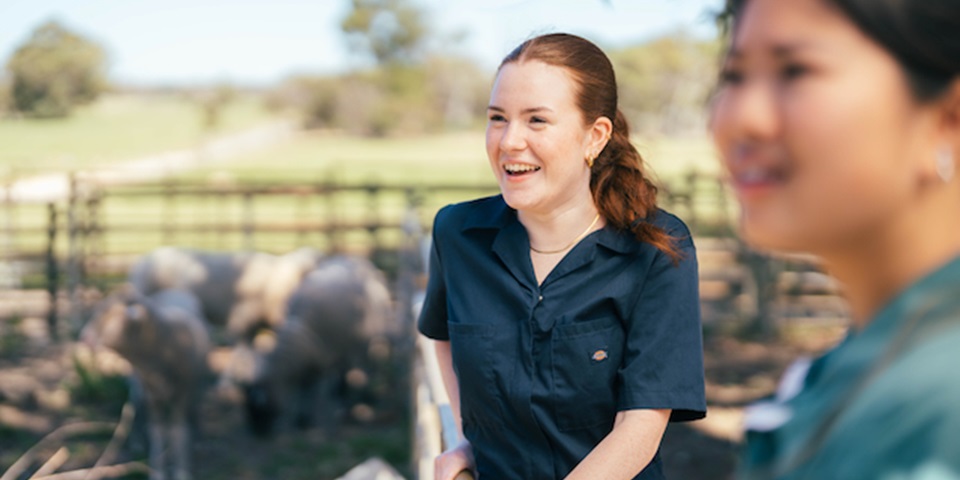
One of the most common questions at Murdoch Open Day and careers events is, "What types of jobs can I do if I study Agricultural Science?"
It's not uncommon for visitors to tell us they hadn't considered a career in agriculture because they are not from the country or don’t want to be a farmer.
It might surprise you to learn that the majority of graduates from Murdoch’s School of Agricultural Sciences are actually from urban areas.
There are so many diverse careers available that you can unlock with a degree in Agricultural Science. Could this be the field for you? See if you identify with any of the below.
Do you:
- Want to work with animals, safeguarding their health and welfare?
- Have an interest in nutrition or how food is created?
- Enjoy caring for plants and the environment?
- Love working with cutting edge technology?
- Wonder how society will address future climate challenges?
- See yourself as both practical and science-y?
- Get excited at the thought of making discoveries?
- Marvel at Australia’s incredible biodiversity?
- Seek a meaningful job, making the world a better place?
If this seems intriguing, read on.
What kind of career can you have with an Agricultural Science degree?
It’s no exaggeration to say that the job opportunities in Agriculture are endless, and growing each year. As innovation revolutionises the way we interact with animals and our environment, Agriculture remains one of the most dynamic industries for emerging professionals. Here are just some of the roles that our recent graduates are thriving in:
- Agricultural scientist: work on the cutting edge of animal, plant and soil health.
- Animal behaviour expert: enhance animal welfare with science.
- Animal geneticist: shape animal health and production, improving particular traits.
- Animal health advisor: use cutting edge science to improve the health and wellbeing of animals
- Animal breeding expert: improving reproduction in domestic or wild animals
- Animal nutritionist: fine-tune animal diets for optimal health.
- Animal welfare inspector: advocate ethical treatment on behalf of animals.
- Agronomist: partner with farmers to fine tune plant production and disease control
- Ag technology: use cutting-edge technology to address complex challenges impacting agriculture and the environment
- Biosecurity officer: be at the forefront of animal or plant disease management.
- Consultant: guide farmers toward more modern, profitable and sustainable practices.
- Crop scientist: develop resilient plants for changing climates and to fight off threats.
- Entomologist: manage insect pests while protecting beneficial species.
- Extension (training) officer: help farmers to translate cutting-edge science to real-world impact
- Farm business manager: combine business expertise and scientific thinking.
- Farm manager: use your skills at the forefront of food and fibre production
- Policy advisor: help businesses and government use science to drive innovation and sustainability
- Plant breeding expert: use advanced science to develop improved plant varieties
- Plant disease scientist: help manage diseases
- Precision agriculture specialist: apply drones, sensors, and AI to boost yields and cut waste.
- Rural finance: support organisations to manage risk and profitability
- Science extension officer: bring research recommendations to life.
- Science journalist: share breakthroughs with media and the wider public.
- Soil scientist: help farmers and industry to farmers to boost productivity and care for the environment.
- Sustainability expert: work with businesses in Australia and communities in developing countries to encourage sustainable farming practice.
- Agricultural economist: shape markets, trade, and farm business decisions.
- Supply chain analyst: keep food and fibre moving efficiently from farm to consumer.
- International development officer: support global communities to improve food security.
- Rangeland ecologist: balance grazing and conservation in fragile landscapes.
- Natural resource manager: ensure farming systems work in harmony with the environment.
No matter what you choose, you can become part of the next generation of agricultural leaders.
Can I get a job? Future-proof your career
The Australian Council of Deans of Agriculture’s most recent report showed there was consistently high demand for graduates, with six jobs for every agriculture graduate. This trend won’t be slowing down either. As the demand sustainable food and fibre production increases, so will the need for educated professionals.
The flexibility and hands-on focus of the Murdoch Agricultural Science degree means you’ll have ample opportunity to explore your interests and build much-needed skills to achieve your career goals. In any given week, this might be at our campus farm, animal hospital and labs, or on a interstate or overseas tour, or at placements in real workplaces whilst receiving credit towards graduation. Not to mention you'll have opportunities to work alongside renowned industry experts at our Research Centres creating the breakthroughs you won't see in text books.
Whether you aspire to be a visionary researcher, an professional focused on sustainability and productivity, or a compassionate animal health expert, Murdoch is your launchpad to success in the ever-evolving world of agricultural science.
Where an Ag Science degree from Murdoch could take you
One of the biggest misconceptions is that a job in agriculture means working in a dusty landscape under the blazing sun, an Akubra hat perched on your head or driving a tractor. This isn’t really accurate. On any given day, your ‘office’ could be a laboratory, animal health clinic, on a board as a business executive, classroom, paddock or barn, or advising officials in the halls of government. Our graduates are employed in cities and well as country locations, in roles that are indoors or outdoors, in laboratories or paddocks or offices. Whether you thrive on variety or consistency, there are options available to apply your skills and make a difference.
If you want to work with animals
An Agricultural Science degree from Murdoch is a great alternative to Veterinary Science. Our Animal Health and Animal Science majors opens up options in animal health and welfare. The Animal Health major can also be combined with majors from other schools, including Conservation and Wildlife Biology.
However if your heart is firmly set on becoming a vet, our Animal Health / Animal Science double major is a great way to transfer into the veterinary program, and provide a solid foundation to build upon.
student story
Career options for Agricultural Science students
Posted on
Topics