
News
What can a bandicoot skull tell us about evolution?
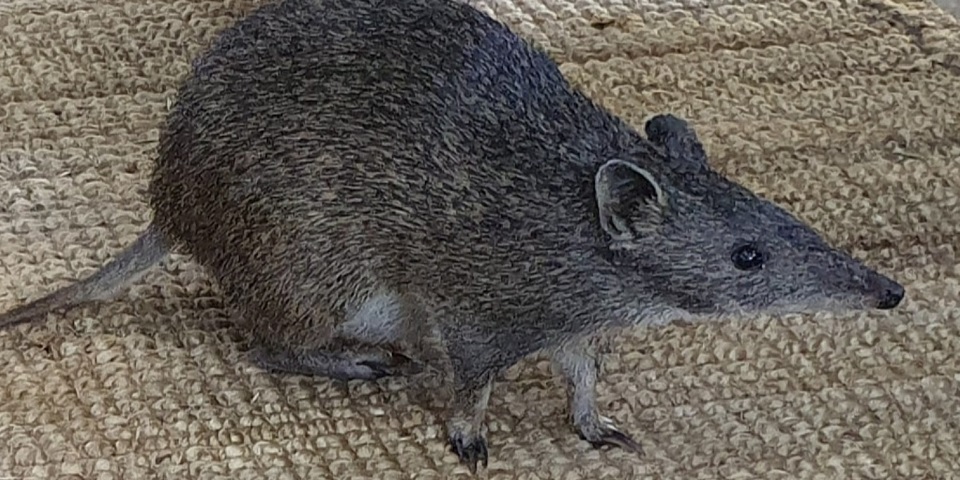
Our local Quenda represents just one part of a remarkably diverse group of marsupials
For many of us at Murdoch University, bandicoots are surprisingly familiar neighbours. Quenda, the south-western subspecies of the southern brown bandicoot (Isoodon fusciventer), are regularly seen around campus, scurrying through vegetation and digging their characteristic small holes as they forage.
But our local Quenda represents just one part of a remarkably diverse group of marsupials.
Bandicoots and bilbies, collectively known as peramelemorphians, occur across Australia and New Guinea and have evolved a striking variety of forms. While most living species are omnivores that dig for food, they occupy different environments and vary considerably in their anatomy. Their evolutionary history also includes forms quite unlike anything surviving today.
New research led by Dr Meg Martin, together with Jo Menard, Kenny Travouillon from the Western Australian Museum and MMFS comparative anatomist Natalie Warburton, has used skull shape to explore how this diversity evolved across the Australian and New Guinean region. The study, Continental-scale adaptive radiation in bandicoots and bilbies (Marsupialia: Peramelemorphia) revealed by cranial shape, was published in the Zoological Journal of the Linnean Society this week.
From short-nosed bandicoots to bilbies
The team used 3D methods to compare the skulls of 127 specimens representing 25 living and extinct species. Rather than simply measuring skull length or width, this approach allowed the researchers to examine the overall shape of each skull and compare subtle anatomical differences among species.
They found remarkable diversity.
Our familiar Isoodon bandicoots have relatively short, robust skulls, while Perameles and several New Guinean bandicoots have longer, narrower skulls. The now-extinct pig-footed bandicoots, Chaeropus, were even more distinctive, occupying an unusual part of the range of skull shapes found across the group.
These differences aren't simply a consequence of some species being bigger than others. Although size influenced skull shape, clear differences remained after body size was taken into account. Males and females also differed mainly in skull size rather than in the overall shape of the skull.
Anatomy records both ancestry and environment
Perhaps most importantly, the study found that skull shape carries information about both where a species came from and the environment in which it evolved.
Evolutionary relationships between species were reflected in their skull anatomy, but geography and climate were important too. Together, climate, geography and size explained 35% of skull-shape variation, with latitude emerging as the strongest individual environmental predictor examined.
The results suggest that changing skull shape, rather than simply becoming larger or smaller, has been an important part of the evolutionary diversification of bandicoots and bilbies across Sahul, the broader geographic region encompassing Australia and New Guinea.
Including extinct species in the study also helps reveal just how much evolutionary diversity has already disappeared. The unusual skulls of extinct forms such as the pig-footed bandicoots show that the living bandicoots and bilbies we see today represent only part of the anatomical diversity that evolved within this group.
Using anatomy to understand our past
The research forms part of Natalie Warburton's broader research programme in comparative anatomy and evolution, using anatomical variation among living and extinct animals to investigate how form, function, ecology and evolutionary history are connected.
This comparative approach also feeds into teaching within MMFS, including forensic anatomy and anthropology, where understanding variation in skeletal anatomy, interpreting form and identifying the biological information recorded in bones are fundamental skills.
From the Quenda digging around the Murdoch campus to extinct bandicoots preserved in museum collections, anatomy provides a record of where animals have come from, how they have adapted and how biological diversity changes through time.
Read the open research article: Continental-scale adaptive radiation in bandicoots and bilbies
News
What can a bandicoot skull tell us about evolution?
Posted on
Topics