
student story
Understanding muscle disease and aging: Dr Nataliya Slater and the Personalised Medicine Centre
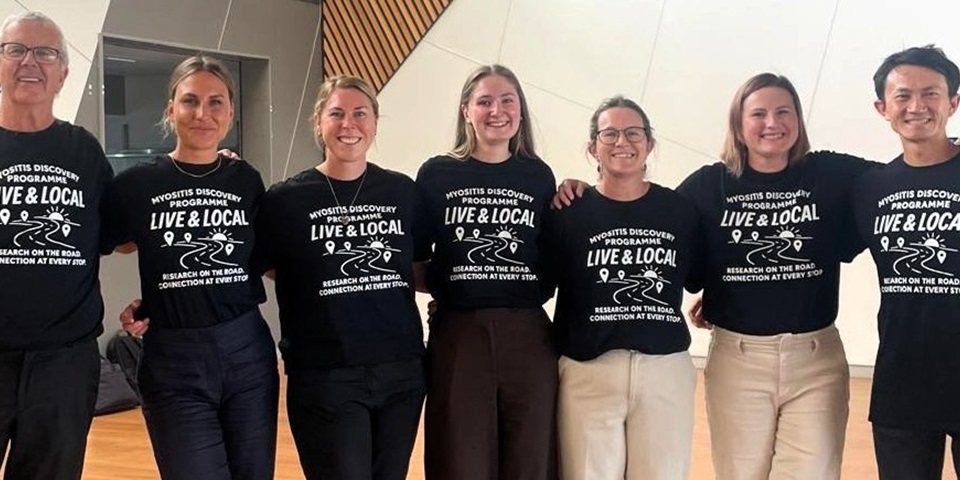
The Myositis Discovery Team at the Personalised Medicine Centre, Murdoch - Dr Nataliya Slater second from right
The Personalised Medicine Centre (PMC) located on Murdoch’s South Street Campus, is a workplace for many MMFS staff and alumni. A collaborative research initiative between Murdoch University and the Perron Institute, the PMC brings together research groups investigating a wide range of rare diseases and developing precision therapies.
Dr Nataliya Slater, is a Murdoch University alumna and is a key researcher leading work in the Myositis team. Nataliya completed a Bachelor of Science, double majoring in Genetics and Molecular Biology and Biomedical Science. The degree gave her a strong foundation across the biological sciences, along with the flexibility to explore different research fields and career opportunities.
Research at the Personalised Medicine Centre, then known as the Institute for Immunology and Infectious Diseases, caught Nataliya’s attention, and she contacted the Centre to ask about future research opportunities. She completed her honours there under the supervision of Dr Jerome Coudert, investigating the use of short DNA fragments to neutralise anti-cN1A antibodies as a potential therapy for IBM. These antibodies are found in approximately half of people with IBM and are believed to contribute to disease progression.
The project proved more complex than initially expected, prompting Nataliya to pursue a PhD and deepen her understanding of the topic. She faced several challenges along the way, including changing the direction of her research and having her original primary supervisor move to Europe. Nevertheless, she completed her PhD in 2025 under the primary supervision of Professor Merrilee Needham. Her research characterised the immune cells and antibodies targeting cN1A in IBM.
Nataliya has since become the science lead of the myositis team. Alongside her research and studies at the Personalised Medicine Centre, she has also demonstrated in MMFS laboratory classes, helping second-year students develop practical immunological skills.
Nataliya recently travelled to St Louis in the United States to present at MyoCon, a global patient conference organised by The Myositis Association. The conference connects people living with myositis with health professionals and researchers, providing practical guidance on managing the condition and opportunities to learn about current research.
Although there is currently no cure or effective treatment for IBM, Nataliya believes the team’s research will make meaningful progress towards understanding the disease and developing targeted therapies. The group is currently investigating the role of T cells in IBM and identifying peripheral markers of the disease.
The MyoDP team has also been invited to contribute to a special myositis edition of Clinical and Experimental Rheumatology, a peer-reviewed journal focusing on musculoskeletal diseases. Scheduled for publication in early 2027, the special issue will include five papers authored by members of the team.
Working in a cutting-edge research facility such as the Personalised Medicine Centre can be demanding, but Nataliya finds the work deeply rewarding. The opportunity to discover something previously unknown, and potentially improve the lives of people affected by rare diseases, makes the hard work worthwhile.
Nataliya also values the strong sense of community at Murdoch, describing the University as “a second home”. Students interested in becoming involved with the Personalised Medicine Centre can find research opportunities and contact details for group leaders on the Centre’s website. Nataliya encourages students to “take the opportunities that are presented to you” and “not to underestimate the value of expanding your social networks”.
Read more about our courses here.
Researched and written by Jamie Lornie MMF302