
Environmental Insecurity Risks in the Indo-Pacific Region
Areas of research
Biosecurity
Lead researchers

John Ruprecht
Director - Centre for Water, Energy and Waste
View staff profile
Jaqueline Lo
Director - Indo-Pacific Research Centre
View staff profile
Chad Hewitt
Adjunct Professor - Centre for Biosecurity One Health
View staff profile
Barbara Kachigunda
Barbara Kachigunda
View staff profile
Tobias Ide
Senior Lecturer in Politics and International Relations
View staff profile
Ali Hayes
Lecturer - School of Humanities, Arts and Social Sciences
View staff profile
Kirsty Bayliss
Associate Professor
View staff profile
Mieghan Bruce
Senior Lecturer
View staff profile
Rochelle Spencer
Fellow - Indo-Pacific Research Centre
View staff profile.tmb-960-banner.jpg?Culture=en&sfvrsn=d91d769_1)
International experts working to anticipate, assess impacts of, and inform preparedness against environmental insecurity risks in the Indo-Pacific region.
Background
The Environmental Insecurity Risks in the Indo-Pacific Region (IPR) project examines the risks associated with natural hazards, pests and emerging diseases leading to socio-cultural, economic and political impacts. It also examines strategic considerations for Australian national security interests. Environmental insecurity is increasing across the region, degrading social, economic and political stability now and over the next decade, directly undermining Australia’s national security interests and commitments.
The project has sought to identify strategic opportunities to enhance environmental diplomacy by examining anticipated environmental security threats that directly impact the socio-economic and political stability of the region. Currently, these disruptions are triggering personnel deployments from the Australian Defence Force, supported by the Department of Foreign Affairs and Trade (DFAT), to provide relief and long-term support in the IPR. There is a need for early warning, preparedness, protection and incident response to natural hazards and disease outbreaks to ensure timely and adequate response to such occurrences. Multiple natural hazards e.g. floods, tsunamis, earthquakes, droughts, cyclonic storms, exacerbated by climate change, economic and geopolitical shocks, pests and disease epidemics, and emerging diseases like COVID-19, have created significant disruptions in the IPR, threatening regional food security. Conflict and insecurity are known to be the primary drivers of food insecurity globally, followed closely by climate shocks and economic turbulence.
The project has brought together academic and government experts from across the IPR, who have formed working groups around three key themes:
Theme 1. The changing scale and rate of natural hazards in the IPR, and differential impact to the national social, economic, and political stability of countries
Theme 2. Increasing food security implications of pests and disease pandemics to plant and animal production in the IPR.
Theme 3. Emerging diseases and management responses across the IPR
The three working groups have evaluated linkages between anticipated changes to, and impacts of environmental threats to social, economic and political stability in the IPR and the resulting implications for defence in terms of strategic planning for preparedness and emergency response and commitments.
SGPG-funded project
The Australian Government’s Strategic Policy Grant Program (SPGP) was established with the aim of supporting independent research, events, and activities which shape the public Australian strategic policy debate, with a focus on Defence and National Security issues, and enhance Defence’s strategic policy advice.
Aligning with the grant objectives, the Environmental Insecurity Risks in the Indo-Pacific Region (EIRIPR) project was funded to focus on the following identified priority topics:
- Threats to human security and state fragility in our immediate region
- Geo-strategic impacts on pandemics
- Threats to national resilience (e.g. disrupted global supply chains
- Impact of climate and disaster resilience for Australia's Defence strategy and capabilities, and practical opportunities for Defence to address the impacts.
The motivation for the research is to provide new insights into the environmental policy debate and demonstrate the significance of non-traditional security threats in our defence strategy. The research has identified a need for a whole-of-government approach to diplomacy, with relevant government departments collaborating and working, proactively even during non-conflict times.
Murdoch University's role
With the grant funding, Murdoch University has administered and managed the project through the Harry Butler Institute with support from the Indo-Pacific Research Centre, hosting several workshops and facilitating themed research programs and communications between partners.
Murdoch University hosted an inception workshop on the 8th of March 2023. The one-day workshop was held in hybrid format (in person and virtual), bringing together more than twenty-five experts from within Murdoch University and partner organisations, academia, and government departments across the Indo-Pacific Region. Later in 2023, Murdoch University hosted three themed workshops for project working groups on the 30th and 31st of August. The sessions were both in-person and virtual, and were well attended, bringing together over forty experts and stakeholders.
A final workshop was held on the 2nd of May 2024 at the Hyatt Regency in Canberra, Australia, bringing together Department of Defence attendees and project collaborators across the IPR for a presentation summarising the results of the project and discussing future directions and funding opportunities for this important work.
The research teams have produced three Policy Brief documents which serve to guide effective policy to address environmental insecurity risks in the Indo-Pacific region identified through the project:
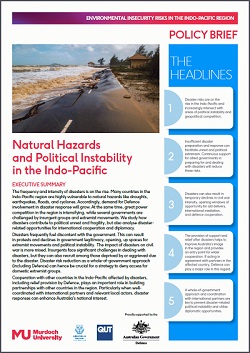
- Natural Hazards and Political Instability in the Indo-Pacific;
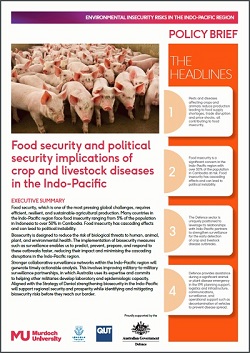
- Food Security and Political Security Implications of Crop and Livestock Diseases in the Indo-Pacific;
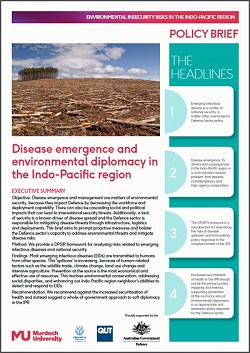
- Disease Emergence and Environmental Diplomacy in the Indo-Pacific
A Final Report of the project has also been produced by lead researchers, documenting key findings and recommendations. Three journal articles, currently under development, will be linked on this webpage once published.

Project partners
This project is proudly supported by:



The research team
Project overview team leaders
Associate Prof. John Ruprect (Murdoch University)
Prof. Jaqueline Lo (Murdoch University)
Dr Barbara Kachigunda (Murdoch University)
Theme 1 team leaders
Dr Tobias Ide (Murdoch University)
Dr Ali Hayes (Murdoch University)
Theme 2 team leaders
Associate Prof. Kirsty Bayliss (Murdoch University)
Dr Mieghan Bruce (Murdoch University)
Theme 3 team leaders
Dr Katie Woolaston (Queensland University of Technology)
Prof. Chad Hewitt (Lincoln University)
Cross-cutting theme leaders
Associate Prof. Rochelle Spencer (Murdoch University)
Dr Indah Larasati (Murdoch University)
Contact
To get in touch, email John Ruprect John.Ruprecht@murdoch.edu.au or Jaqueline Lo Jacqueline.Lo@murdoch.edu.au.
Lead researchers
Areas of research
Biosecurity
Lead researchers
John Ruprecht
Director - Centre for Water, Energy and Waste
View staff profile
Jaqueline Lo
Director - Indo-Pacific Research Centre
View staff profile
Chad Hewitt
Adjunct Professor - Centre for Biosecurity One Health
View staff profile
Barbara Kachigunda
Barbara Kachigunda
View staff profile
Tobias Ide
Senior Lecturer in Politics and International Relations
View staff profile
Ali Hayes
Lecturer - School of Humanities, Arts and Social Sciences
View staff profile
Kirsty Bayliss
Associate Professor
View staff profile
Mieghan Bruce
Senior Lecturer
View staff profile
Rochelle Spencer
Fellow - Indo-Pacific Research Centre
View staff profile