
News
Research Project Milestones from New HDR Scientists
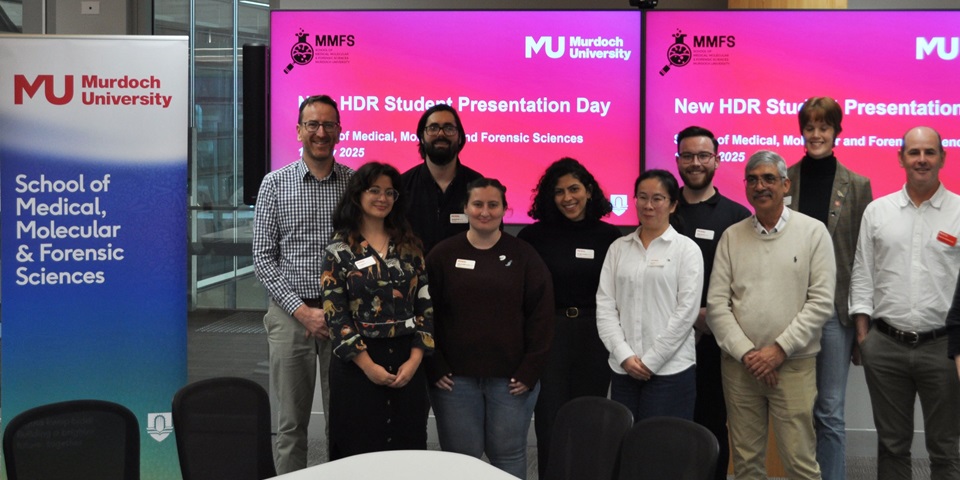
On Thursday 17th July, MMFS welcomed our next round of HDR candidates as they gave their project proposal seminars.
The School of MMFS is excited to highlight a dynamic suite of new research project proposals from our emerging research community, reinforcing our commitment to fostering a supportive and inclusive environment for the next generation of scientists. These projects span a range of fields—agriculture, medical genomics, evolutionary biology, food science, and environmental microbiology—demonstrating the breadth of MMFS research.
Colby Hymus: Maximising DNA Recovery from Challenging Casework Samples to Improve Profiling and Intelligence Outcomes
Colby’s research centres on optimising forensic DNA methods to enhance the recovery, quantification, and analysis of genetic material from difficult casework samples. By refining sample collection practices, improving DNA extraction and quantification protocols, and exploring alternative approaches such as sperm cell separation, the project aims to generate more complete DNA profiles. These improvements can support more accurate forensic profiling and strengthen intelligence outcomes in criminal investigations.
Amy Naicker: Scared, weird, little guys: anatomy and scaling of pelvis and hindlimb muscles in Australian small mammals
Amy's research tackles the question of how muscular anatomy, body size, and locomotor ecology interact in some of Australia’s most overlooked native mammals. By studying the pelvis and hindlimb musculature of tiny marsupials and placental mammals, the project will test whether these little guys conform to established scaling hypotheses—ideas about how anatomy and movement should change with body size. This investigation aims to illuminate whether the biomechanics and muscular patterns of these miniature mammals follow expected trends or reveal unique adaptations, enriching our understanding of evolutionary biology and the functional diversity of Australia’s native fauna.
Marshall Tye: Evolution and Diversity of Bacteria in Chickpea Symbiosis
Marshall’s proposal explores the complex relationships between chickpea plants (Cicer arietinum) and their symbiotic bacteria, Mesorhizobium. By focusing on the evolution, diversity, and the role of mobile integrative and conjugative elements, the project aims to provide new insights into nitrogen fixation and its implications for sustainable agriculture. Understanding these interactions may help improve crop yields and reduce reliance on chemical fertilisers.
Carolina Amaral: Exploring Transposable Elements in Parkinson’s Disease
Carolina proposes investigating how “jumping genes” (transposable elements) may contribute to the progression and diversity of symptoms in Parkinson’s disease. Utilising a combination of genomics and proteomics, as well as integrating multiple longitudinal and global datasets, her project seeks to identify molecular markers that could enable earlier, more personalised diagnosis and tailored treatments for patients.
Chloe Karafilis-Brown: Evolutionary History of Koalas, Wombats, and Tasmanian Devils in Southwest WA
Chloe’s proposal delves into the evolutionary history and interspecific variation of three iconic marsupials in southwestern Western Australia. By analysing skull shape and comparing modern animals with Pleistocene fossils, she aims to understand the drivers of their diversity and determine whether some fossils represent distinct species, enriching our knowledge of Australia’s unique biodiversity.
Ting Zhou: Consumer Perceptions and Sensory Evaluation of Oat-Based Foods
Ting’s project focuses on the development and testing of oat noodles as a novel, protein- and vitamin-rich food source. The project will examine both nutritional content and how consumers perceive and enjoy these products through sensory evaluation, aiming to advance healthy and sustainable food choices in Australian diets.
Selena Lloyd: Mobile Genetic Elements in Australian Water
Selena proposes to investigate the prevalence and movement of mobile genetic elements in bacteria found in Australian wastewater. By analysing samples for strains resistant to antimicrobials, this project will contribute to our understanding of how antibiotic resistance spreads in the environment, informing future strategies for public health and water safety.
These proposal projects exemplify MMFS’s dedication to advancing science across disciplines and building an inclusive community where all researchers have the opportunity and support to pursue their innovative ideas.
Stay tuned to the MMFS website for updates on these projects and other exciting developments.