
student story
Imagine using insect skin to help solve crimes
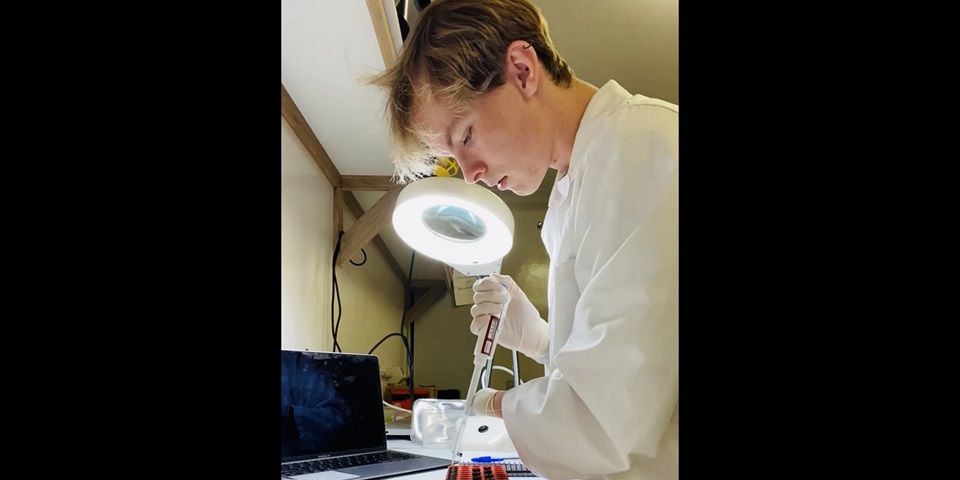
FameLab 2025 finalist Bobby Stewart-Yates is combining biochemistry, toxicology, and entomology in his Forensic Science Research
Cuticular Hydrocarbons (CHCs) are the compounds found on the outermost layer of insects, often described as an insect’s “chemical fingerprint”. Forensic science PhD candidate Bobby Stewart-Yates, recently completed his Honours research investigating how CHCs can be used to identify insects and, thus, add to crime-solving evidence.
Bobby completed his Bachelor’s degree at Murdoch, majoring in Forensic Biology and Toxicology, before completing his Honours degree in the same field. He was always interested in biochemistry and the role of toxicological substances in poisonings. Through his studies, he worked in various forensic fields, including forensic entomology, where students learnt about the importance of insects at crime scenes. Through undergraduate units such as BIO315: Bodies of Evidence, students can investigate mock crime scenes, collect insects and analyse them under real-world lab conditions.
Forensic entomology, a branch of forensic science, focuses on insects, particularly blowflies, and their presence at crime scenes. Bobby researched a new technology that can efficiently determine the species of a blowfly and estimate their age, both essential aspects in estimating a postmortem Interval (PMI), or the time between death and discovery.
A major limitation in current forensic entomology is the species investigation techniques used, in which highly specialised taxonomists must study insect appearance to determine their species. These methods also require that any young samples collected be grown to adults under lab conditions to allow for age estimation. As Bobby’s studies progressed, he learnt about CHCs. This new technique allows quantitative measurements to determine species and estimate age, allowing for much more reliable and accurate results and methods that non-specialised forensic scientists can use. He quickly gained interest in how these interdisciplinary approaches can enhance forensic investigations. His interest in combining biochemistry, toxicology, and forensic entomology led to his Honours research in the new field of forensic entomotoxicology, a mix of entomology and toxicology.
Under the supervision of forensic entomologist, A/Prof. Paola Magni, and toxicologist, A/Prof. Garth Maker at Murdoch University, Bobby homed in on gaps in current research, studying the effects of a common household pesticide, glyphosate (commonly known as Roundup), on blowfly CHCs. Studying the impact of glyphosate on CHC modification is important due to its widespread implication in poisonings, especially self-poisonings and fatal accidental poisonings.
“Honours is a challenging but very rewarding pathway,” says Bobby, “especially when your research is promising and generates an important starting point for future studies.”
Now a PhD student at Murdoch researching drug-facilitated sexual assault and the impact of drugs on case interpretation, Bobby views his journey through Bachelor’s and Honours as essential stepping stones that shaped the path to his broader mission of advancing forensic science through research.
By Lauren Daniels
Find out more about our courses in Forensic Science - https://www.murdoch.edu.au/schools/medical-molecular-and-forensic-sciences/study/forensic-science