
student story
Student Spotlight: Following the Chemistry of Poison Peas
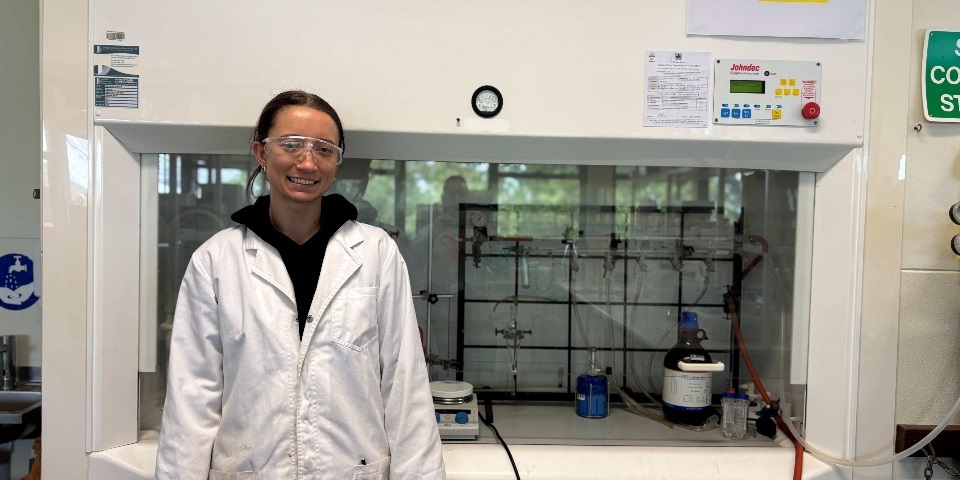
Juliette King, PhD candidate in Chemistry in the School of Mathematics, Statistics, Chemistry and Physics at Murdoch University
From a fascination with forensics to working hands-on with some of Western Australia’s most toxic native plants, PhD student Juliette King is carving out a research path that sits at the intersection of chemistry, conservation and curiosity.
Juliette is a PhD candidate in chemistry here at Murdoch University, situated within the School of Mathematics, Statistics, Chemistry and Physics, and supported by the Food Futures Institute and King’s Park Science. Her research is focused on the phytochemistry of Gastrolobium—a group of native Australian plants more commonly known as poison peas.
Gastrolobium are native to the south-west of Western Australia and are known to bioaccumulate the toxic compound fluoroacetate and perhaps others. Plants tend to produce toxins as a defence to herbivory, yet this toxin is quite uncommon. Fluoroacetate, in its sodium salt form is better known as the invasive predator baiting poison “1080”. Juliette seeks to understand why fluoroacetate accumulates in Gastrolobium species and learn more about its evolutionary significance. Further, through partnering with King’s Park Science, Juliette and the team are investigating the impacts that climate and environmental factors (such as drought stress) upon fluoroacetate accumulation in these plants.
For Juliette, the road to this research began well before her PhD.
“I’ve always loved chemistry, particularly its link to forensics,” she says.
Juliette completed a Bachelor of Science majoring in chemistry at Curtin University, followed by a Master of Forensic Science at Murdoch University. It was during the research component of her master’s degree—focusing on toxins in common backyard plants—that she discovered a passion for independent research and laboratory work.
“The autonomy really clicked for me,” Juliette reflects. “Being able to explore questions deeply, problem-solve, and follow your curiosity is incredibly rewarding.”
Her PhD project, titled “Revisiting Gastrolobium phytochemistry: what’s so poisonous about these poison peas?”, builds on this foundation. In simple terms, Juliette is investigating the chemical makeup of these plants to better understand the compounds responsible for their toxicity. This work has significance far beyond the laboratory, contributing valuable baseline data for native plant species in south-west WA and supporting broader environmental and land management practices.
Supervised by Dr Todd Gillam, alongside co-supervisors Dr John Coumbaros, Dr Samuele Sala from Murdoch University, Dr Gavin Flematti from the University of Western Australia and Dr Wolfgang Lewandrowski and Dr Emily Tudor from Kings Park Science, Juliette’s research also has a strong conservation focus. Through key experiments performed at Kings Park, she is examining how these plants respond to environmental stressors such as drought, helping to inform conservation strategies for native and potentially endangered flora.
Dr Gillam speaks highly of Juliette’s approach to research.
“Juliette brings a genuine curiosity and thoughtfulness to her work,” he says. “Juliette has entered her PhD with a strong background and passion for native plants, she is embarking on a fascinating multidisciplinary project and continues to impress me with how readily she picks up new skills. Her project has real potential to contribute meaningfully to our understanding of native plant chemistry and its applications.”
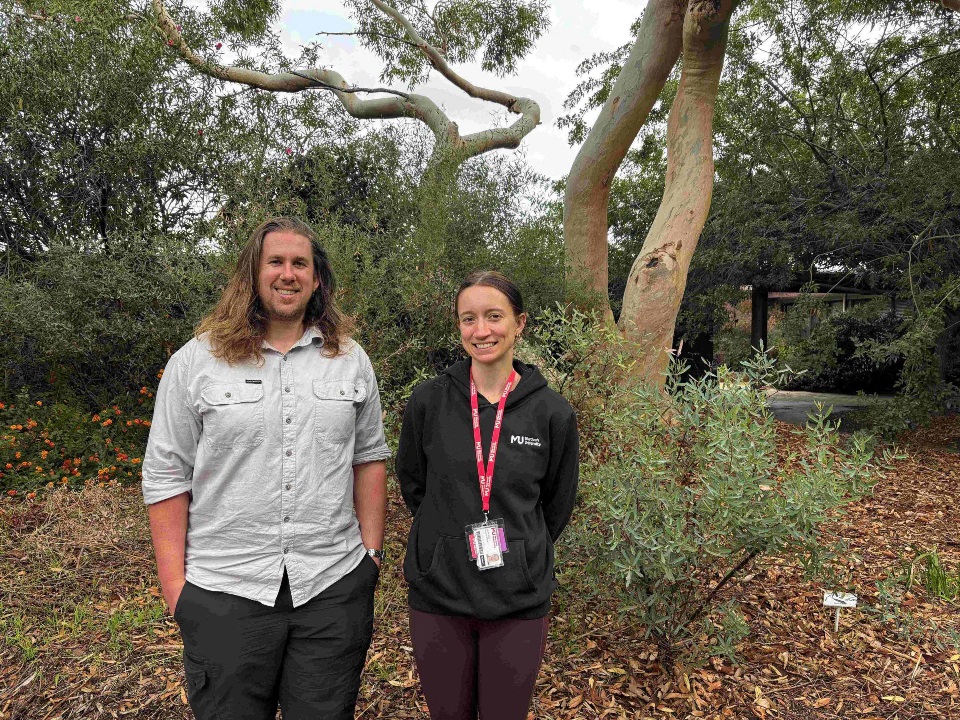
Supervisor, Dr Todd Gillam and Juliette King, PhD candidate in Chemistry both in the School of Mathematics, Statistics, Chemistry and Physics.
One of the most enjoyable aspects of the PhD for Juliette has been the balance between laboratory work and time spent outdoors. Fieldwork trips to national parks to collect samples—and regular visits to Kings Park to monitor plants she has germinated herself—are particular highlights. “Keeping the plants alive has honestly been one of the most satisfying parts,” she laughs. “Watching them thrive when you come back after a few weeks is incredibly rewarding.”
Juliette recently passed her Confirmation of Candidature, a milestone she describes as deeply meaningful. “It was something I’d been looking forward to since my undergraduate days,” she says. “It feels like an important personal and professional marker.”
Looking ahead, Juliette hopes to remain connected to both research and teaching. She currently enjoys undergraduate laboratory demonstrating and can see herself continuing along an academic teaching pathway while further developing her research career.
Her advice to students considering a PhD is simple but heartfelt: “Choose a topic that genuinely interests you and make sure you have strong support around you—whether that’s supervisors, friends or family. Those two things have made my experience really positive so far.”
Juliette is quick to acknowledge the people who have supported her journey so far, including her supervisory team, her friends, family, and the Food Futures Institute.
Through her work on poison peas, Juliette King is not only uncovering the chemistry behind one of Australia’s most intriguing plant groups, but also contributing to knowledge that supports conservation, environmental management, and future scientific discovery.