
News
Collaborate with the School of Indigenous Knowledges
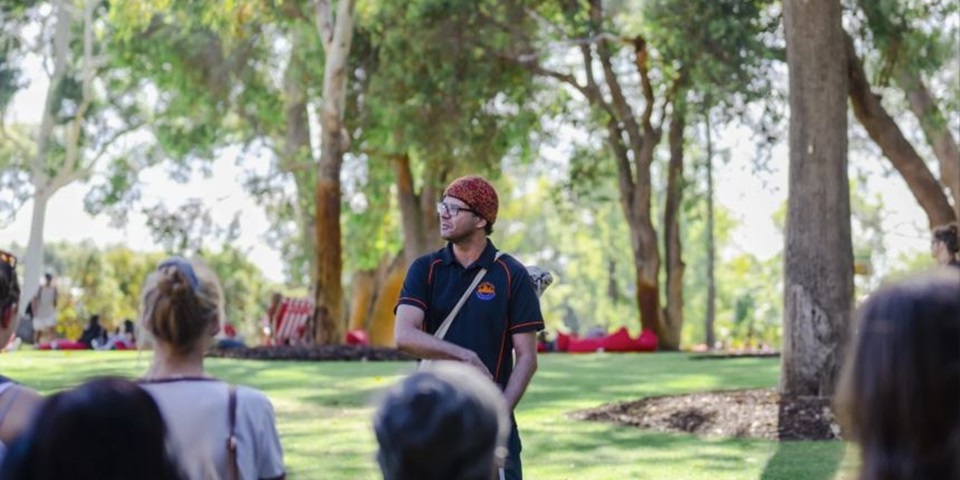
The School of Indigenous Knowledges (SIK) helps students develop critical thinking skills, become more socially aware and introduces them to different perspectives and worldviews that complement Western-based disciplinary knowledge.
Through SIK, students learn from Aboriginal experts across a range of fields and are connected to Country. These teachings are underpinned by the principles of truth telling and social justice.
By studying Indigenous Knowledges and Practices at Murdoch University, students and graduates will be able to apply Indigenous Knowledges within any field of practice. They will learn how to make a commitment to truth telling, reconciliation, relationship-building, and make positive contributions within Aboriginal and Torres Strait Islander communities.
As part of our commitment to embracing Indigenous Knowledges and allyship, academics from all Schools and Majors across the University are invited to consider recommending the co-major in Indigenous Knowledges and Practices to their students.
Dean of the School of Indigenous Knowledges, Associate Professor Jenna Woods said she welcomes all conversations to integrate Indigenous Knowledges across our courses.
“We’d love to have a yarn with any academics who are interested in establishing a connection with the School of Indigenous Knowledges,” Jenna said.
“Students can either complete a full minor or choose to do SIK units as electives. It’s a great opportunity for them to see another perspective and the course will help them to grow into more socially aware people.”
Currently, several Schools have collaborated with the School of Indigenous Knowledges and recommend the co-major as part of their course structure.
Sarah Etherington from the School of Medical, Molecular and Forensic Science said she has seen the positive impact that First Nations perspectives have for their students.
“The School of MMFS have been very grateful to partner with the School of Indigenous Knowledges over the last couple of years to co-design and co-deliver two-ways science content for our students. This was all new for our School and we’ve been thrilled to see students’ enthusiastic engagement with the material,” she said.
“Our students told us that they came in knowing a little about Noongar culture, but often saw it as something historical and distant to their own lives. Through engagement with activities from the School of Indigenous Knowledges, students discovered that First Nations science and culture are current, evolving, and actively present on campus."
- Sarah Etherington, School of Medical, Molecular and Forensic Science
“Excitingly, students also become aware of how easily School of Indigenous Knowledges offerings (units, co-majors) can be incorporated into their science degree, adding depth to their science learning and providing a point-of-difference for employers.”
Other courses with strong course integration include Major in Community Development, Bachelor of Food Science and Nutrition, Bachelor of Criminology and Bachelor of Communication.
The integration of the School of Indigenous Knowledges units and courses within other School’s structures enables students to access Indigenous knowledges that are relevant to their disciplines.
“Through these partnerships, we are able to engage students to think more holistically about their area of study, to consider the perspectives and learnings from the world oldest living culture and apply these within their areas of interest,” Jenna said.
Unit Spotlight: Hot Topics in Indigenous Australia (SIK200)
Offered inside the minor (and as a general elective), the unit Hot Topics in Indigenous Australia (SIK200) explores several current debates on matters of importance to Indigenous communities and mainstream Australia.
Tutors take students through a deep dive into the discourses both for and against and critically reflect on how they shape political action in these spaces. Examples of issues they’ve covered include Change the Date, politicising sports and the ‘Woke’ Movement.
A broad range of voices are examined, including leading Aboriginal and non-Aboriginal thinkers from across the political spectrum and community sector, many of whom hold conflicting reasoning behind their positions. The unit analyses the role of the media, existing power structures and socio-political history to show their significant role in shaping current debates on topics related to Indigenous Australians.
News
Collaborate with the School of Indigenous Knowledges
Posted on
Topics