
News
Drones, Data, and Disease Control: Hai Wang Leads Cutting-Edge Crop Protection Project
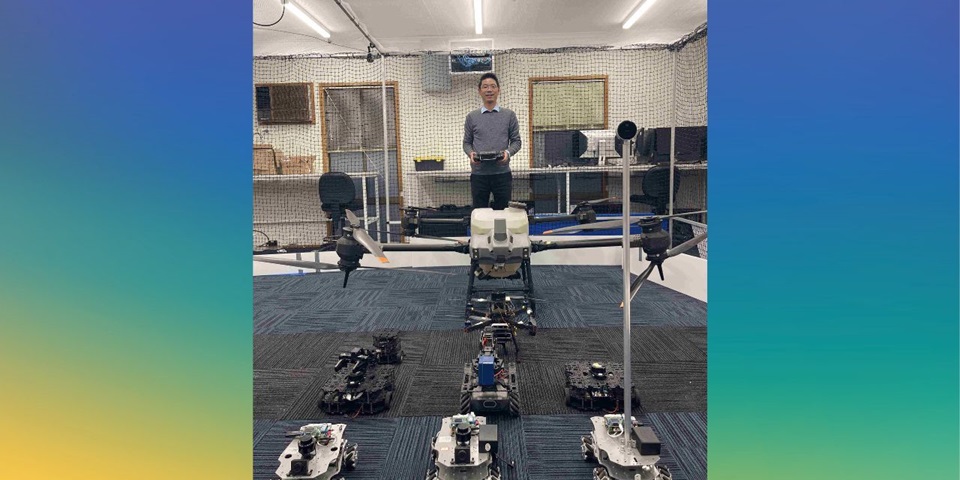
Dr Hai Wang, Associate Professor of Electrical Engineering (Robotics & Mechatronics stream), School of Engineering & Energy, Murdoch University
The School of Engineering and Energy is proud to celebrate Associate Professor Hai Wang's recent success in securing $207,878 in research funding through the Grains Research and Development Corporation (GRDC) Proof-of-Concept program. This funding supports a pioneering initiative that could transform how fungal diseases are managed in cereal crops across Australia.
The project, titled Artificial intelligence and edge computing–driven intelligent drone systems for advanced fungal control in crops with precise UV-C light treatment, is designed to address a growing challenge in agriculture: the increasing resistance of fungal pathogens to conventional fungicides. Hai Wang and his team are developing autonomous drones that use AI-powered detection to identify early-stage fungal infections in crops like barley, oat, and wheat. These drones scan fields during the day using multispectral and RGB imagery, then return at night to deliver targeted, chemical-free UV-C light treatment to infected plants. The goal is to reduce pesticide use, improve crop yields, and promote sustainable farming practices.
This initiative brings together a multidisciplinary team of researchers from Murdoch University, combining deep expertise in robotics, artificial intelligence, agronomy, and systems engineering. The project team includes Professor Chengdao Li (crop genetics and pathology), Dr Amirmehdi Yazdani (robotics and AI deployment), Professor Farhad Shahnia (software and hardware optimization), Dr Mark McHenry (UV-C treatment validation and field feedback), and two research officers focused on drone and AI technological development. Their collective experience ensures the project is grounded in both cutting-edge technology and practical relevance for broadacre farming systems.
The idea for the project emerged from the Robotics & AI Research Lab led by Hai Wang, which has been actively engaged in smart agriculture research since 2019. Through ongoing collaboration with colleagues and stakeholders in the grain industry, the team identified an escalating challenge: the increasing resistance of fungal pathogens to fungicides, which threatens crop health and productivity across Australian farms. Recognising the urgent need for innovative approaches, the team partnered with experts in crop genetics and field agronomy to develop a technologically advanced solution that leverages real-time data, targeted interventions, AI, and intelligent robotics to improve the detection, monitoring, and management of fungal infections in cereal crops.
Reflecting on the journey, Hai Wang shared, “We’ve been working on robotics and AI for smart agriculture since 2019, and this project is a natural evolution of that work. It’s exciting to see how technology can offer real, sustainable solutions to problems that farmers face every day. Our goal is to create a system that’s not only intelligent and autonomous, but also environmentally responsible.”
The project runs for 18 months and is expected to be completed by November 2026. It involves several key engineering disciplines, including robotics and autonomous systems, edge computing and embedded systems, artificial intelligence and machine learning, and system architecture and integration.
This joint initiative between Murdoch University’s robotics and agricultural research teams is further strengthened by the active participation of grain growers and agronomy experts across Western Australia, who provide invaluable insights and support for field validation. Through this partnership, the project aims to demonstrate a data-driven, environmentally sustainable alternative to conventional chemical-based disease management. By leveraging advanced robotics and AI, the solution is designed to minimize fungicide use, slow resistance development, and reduce environmental impact, while maintaining productivity in broadacre cropping systems.
The team is particularly enthusiastic about the potential of this technology to transform disease management practices in the grains industry. Building on the initial success and learnings from the GRDC Proof-of-Concept phase, they are actively exploring pathways toward large-scale deployment and commercialisation in collaboration with key industry partners.
News
Drones, Data, and Disease Control: Hai Wang Leads Cutting-Edge Crop Protection Project
Posted on
Topics