
Return to Our Story page
News
Murdoch University Vice Chancellor and President, Professor Andrew J. Deeks reflects on “Beeliar Boodja Bidi” by Christopher Pease
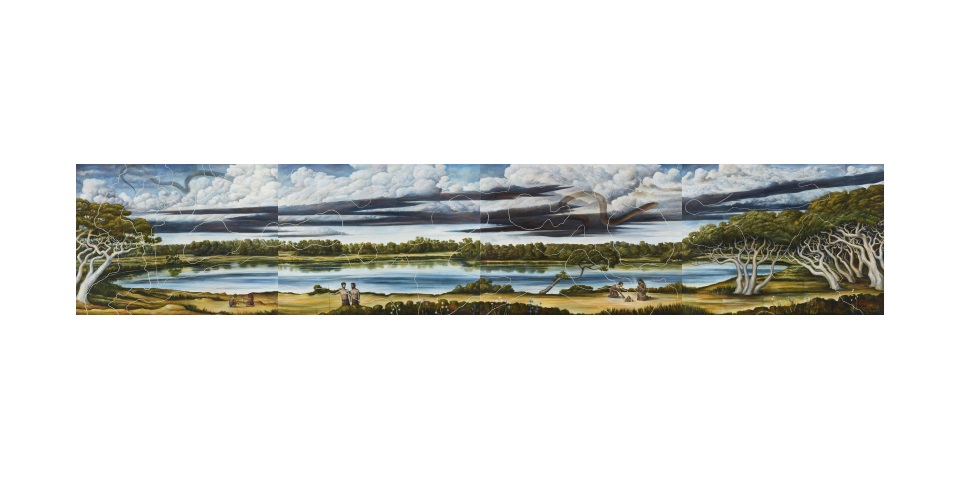
Christopher Pease – “Beeliar Boodja Bidi”, 2022, oil on Belgian linen, 150cm x 800cm. Commissioned for Boola Katitjin 2022. Image courtesy of the artist.
Respected Noongar artist, Christopher Pease’s painting Beeliar Boodja Bidi presents a visualisation of how the Beeliar wetlands that run through the Murdoch University South Street campus looked in precolonial times. The painting’s composition is superimposed with the contours of the wetlands as they now exist, representing the imposition of Western culture on indigenous ways of life. For me, the painting is a beautiful representation of the history of the Australian landscape and brings back memories of a single lecture which completely changed my understanding of this history.
I grew up in North Beach, in a house with a back gate that opened on to the bushland surrounding Charles Riley Reserve, and attended North Beach Primary School, which opens on two sides to what is now the Star Swamp Reserve. While the bush was much more extensive at that time, remnants remain. I spent much time exploring and playing in the bushland, building cubbies, climbing trees, catching bobtailed lizards and bringing them back to our garden, and more.
While the bush was a great place to play, it was messy and overgrown in many places, particularly around star swamp. As a child, I assumed this is how it had always been. At school we learned that before ‘settlement’ Aboriginal people were primitive hunter-gathers, constantly on the move to find food, and that they had no civilisation and created no archaeology.
I was fortunate that, after some 25 years working at The University of Western Australia, my career took me first to Durham University in the United Kingdom, and then at the beginning of 2014 to Ireland to become President (Vice Chancellor equivalent) of University College Dublin (UCD), Ireland’s largest university. By coincidence, the UCD School of History had an Australian Studies Centre which each year organised a public lecture on Australian history given by a distinguished visiting academic (usually from Australia). I learned more about Australian history attending those lectures than I did at school here in Australia!
In 2016, the lecture was given by (now Emeritus) Professor Bill Gammage and was titled ‘How Aborigines Made Australia’. The lecture was largely drawn from his book titled The Biggest Estate on Earth, which won the 2012 Prime Ministers Literary award for Australian History, amongst other accolades.
Gammage challenged the European perception that Australia was untouched wilderness before colonisation. He provided evidence that the land was actively managed and cultivated by Aboriginal people, transforming it into a productive and diverse landscape. He used historical records, early settler observations, and ecological evidence to support his arguments, drawing upon accounts from explorers and settlers who noted the park-like landscapes and abundant wildlife, often commenting on the neatness and order of the land. He explained that post-colonisation, Aboriginal land management techniques were banned or abandoned, European farming methods were implemented, and the land subsequently deteriorated.
I found Gammage’s arguments cohesive and convincing, and my understanding of the relationship of our First Nations’ peoples to the land was transformed.
Pease’s painting beautifully recreates that pre-colonial landscape and the harmonic relationship between Noongar people and the land. It stands in stark contrast to the current state of the Beeliar wetlands. My hope is that over the next few years we can work together with our Noongar community to restore at least some of that land to something resembling Pease’s representation.
About Andrew J. Deeks
BE(Hons) MEngSc PhD CEng FIEI FIAE FIEAust
Andrew Deeks was appointed to Murdoch University from University College Dublin (UCD), where he was the first Australian to lead an Irish university.
Since joining Murdoch University, he has overseen an academic restructure, a refresh of the senior leadership team, and the development of a new strategy, Ngala Kwop Biddi: Building a Brighter Future, Together, which has been warmly embraced by the university community.
Andrew was President of UCD from January 2014 to March 2022, and developed a strategy which led to significant improvements across a range of areas, including student satisfaction; quality, quantity, and impact of research; and local, national, and international engagement.
Prior to his role at UCD, he was a Pro-Vice-Chancellor at Durham University, where he led the Science, Engineering and Technology division and contributed to the development of extensive international and industry partnerships. Before joining Durham, he was the Winthrop Professor in Civil and Resources Engineering at The University of Western Australia and was Head of School from 2004 to 2009.
Professor Deeks’ research has focused on structural dynamics, mechanics and dynamic soil structure and he has published more than 150 research papers in this area.
Professor Deeks is President of the International Association of Universities. He is a Fellow of the Irish Academy of Engineering, the Institution of Engineers Ireland, and the Institution of Engineers Australia.
News
Murdoch University Vice Chancellor and President, Professor Andrew J. Deeks reflects on “Beeliar Boodja Bidi” by Christopher Pease
Posted on
Topics