
Return to Our Story page
News
Murdoch University Associate Professor and Academic Chair of Philosophy Anne Schwenkenbecher reflects on “The River” by Rebecca Dagnall
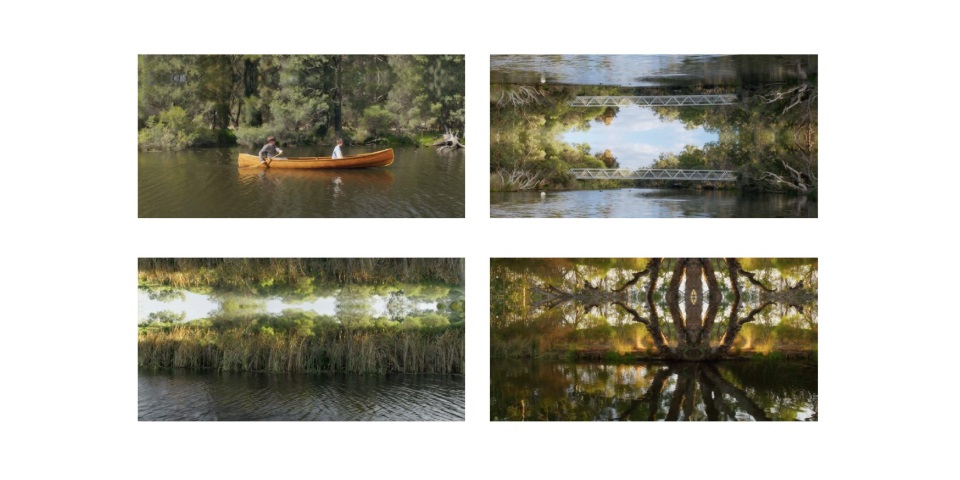
Stills from Rebecca Dagnall’s “The River”, 2022, single channel HD video with sound, 59:17 minutes, edition 1 of 5. Commissioned for Boola Katitjin 2022. Image courtesy of the artist. Displayed (on rotation) in Boola Katitjin’s Level 3, Student Hall.
In my native Berlin and the surrounding state of Brandenburg rivers and lakes shape the landscape as much as they shape people’s lives. As a child and young adult, every morning, my friends and I would take the ferry to school, crossing the slow moving, wide and greenish-coloured Dahme river in the Southeast of Berlin. When the river would freeze in winter the ferry would stop operating. Only then did we brave the detour to the nearest bridge, crossing the old town of Köpenick that sits on an island formed between merging rivers. Ice on the river meant a delightful break from daily routine. And that we would all be late for school. In Köpenick, the Dahme river unites with the larger Spree which passes through the centre of Berlin, forming the famous museum island – part of an extensive system of waterways that eventually flows into the Nordic Sea. Brandenburg alone has 3,000 lakes. I spent my early adolescence growing to love kayaking and canoeing: What the road trip is to Australian Youth to us was the paddling holidays. Moving in our boats between wilderness and civilisation, campfires at night and beer gardens by day, careful to never capsize with all our gear in not-always-so-waterproof bags.
Perhaps that is why, when I moved to Perth in 2013 to start my new role in Philosophy one of the first things I purchased was a river canoe. Whilst initially doubting the expediency of my somewhat nostalgic acquisition in a city so focused on the beach and the ocean, my boat came into its own when I discovered the Canning River and the meandering wilderness around Kent Street Weir.
Naturally then, I was instantly drawn to Rebecca Dagnall’s video artwork titled The River. Its an artwork inspired by childhood memories of her dad taking her canoeing on the Canning River. Everything about this artwork resonates with me: the peacefulness of the canoe moving on the water, the sense of awe at the natural world around us and the playfulness of the ever shape-shifting riverscape Rebecca has created. I have known Rebecca and her work for more than a decade and I am so incredibly pleased this beautiful artwork was commissioned to be part of Murdoch University’s Art Collection and that it found its way into a cosy lounge suite at the heart of Boola Katitjin.
In Rebecca’s mesmerizing artwork, as the canoe glides down the river, the natural surroundings begin to change. Horizons shift and tree portals seem to open and close. Nature is full of wonders in Rebecca’s artwork, and it is always more than what the eye can see. It’s mysterious and intriguing but never threatening. The River reminds me of an evening canoeing with a friend on the Canning River. Dusk was settling in and as the light faded, the lush green around us turned grey. The rising mist made the line between water and horizon disappear. The landscape’s features dissolved into grey wafts and finally it was as if the river itself had vanished. As we were gliding through the thick mist, one stroke of the paddle at a time, moving and yet stranded, we felt wonderfully lost. Rebecca’s absorbing artwork evokes that same memorable feeling of being comfortable in letting go the need to know where you are going and resisting the urge to define what it is that you’re seeing.
About Anne Schwenkenbecher
Anne Schwenkenbecher is Associate Professor and Academic Chair of Philosophy in the School of Humanities, Arts and Social Sciences (HASS). She is a member of the Indo-Pacific Research Centre and the Harry Butler Institute.
Her research is on theories of collective action and obligations, including our responsibilities to act on climate change and environmental harms. She also works on misinformation and its emergence in polluted epistemic environments. A final strand of her research is in evidence-based policy and the entanglement of evidence with values. Her 2021 book Getting Our Act Together: A Theory of Collective Moral Obligations won the North American Society for Social Philosophy’s 2022 book award. That year, Anne was also awarded Murdoch University’s Vice Chancellor’s Excellency Award in Research and Innovation.
For her project on the philosophy of public policy, Anne has received more than A$500,000 funding from the Centre for Interdisciplinary Research at the University of Bielefeld in Germany to co-lead an international group of scholars during a 5-month residency in 2023. Anne is currently the Associate Dean of Research for the School of Humanities, Arts and Social Sciences.
News
Murdoch University Associate Professor and Academic Chair of Philosophy Anne Schwenkenbecher reflects on “The River” by Rebecca Dagnall
Posted on
Topics