
News
Murdoch Professor Wins ARC Grant to Explore Nature’s Nanotechnology
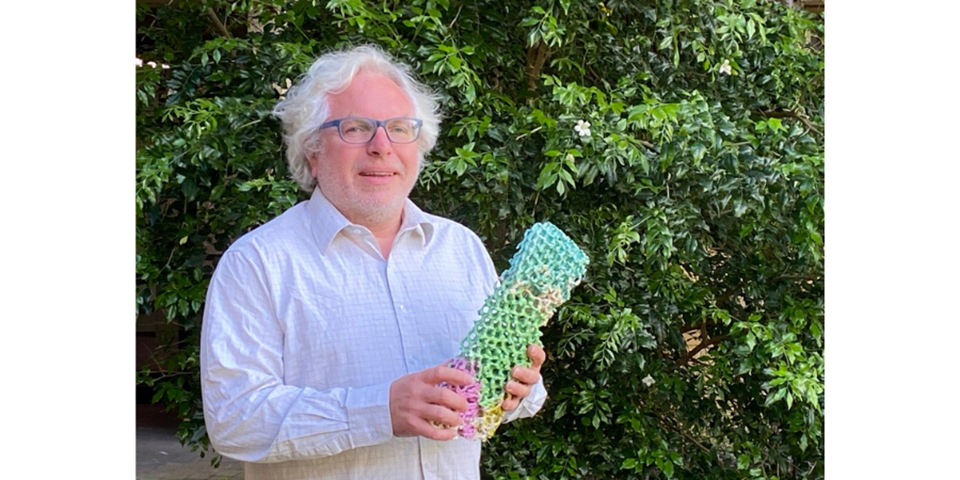
Gerd Schroeder-Turk, Professor in Mathematics and Statistics at Murdoch University.
Unlocking the Secrets of Butterfly Wings
Professor Gerd Schroeder-Turk’s fascination with the hidden architecture of nature has led to a major milestone for the School of MSCP. Recently awarded a prestigious Australian Research Council (ARC) Discovery Project grant totalling $551,498, Gerd and his international team will investigate how butterflies create their dazzling, microscopic gyroid structures—complex geometries that give certain species their vivid colours.
Unlike pigments, the brilliant green of the Emerald-patched Cattleheart butterfly is produced by a natural three-dimensional (3D) nanostructure called a gyroid, woven inside the butterfly’s wing scales. Gerd’s curiosity about how nature self-assembles such intricate forms has driven two decades of research, culminating in this new project. “I came to the butterflies not out of interest in butterflies per se, but an interest in the nanostructure that the butterflies form—a structure called the gyroid, a particularly complicated 3D geometry,” Gerd shared.
The project aims to answer a fundamental question: how does nature manage to fabricate such complex structures at a scale that still eludes modern materials engineering? The team will use advanced microscopy and modelling to observe, in the living butterfly pupa, how these nanostructures emerge during the butterfly’s development—a scientific first with potential for biomimetic materials, pharmaceuticals, and even sustainable manufacturing.
A Team Effort and a New Generation of Scientists
The project brings together experts from Murdoch University, The University of Western Australia, the University of Salzburg, the National University of Singapore, and the Smithsonian Tropical Research Institute. Their combined expertise spans physics, biology, chemistry, and advanced imaging. The team will not only study the butterfly’s gyroid structures but also compare them to similar forms found in other species and even in synthetic materials, hoping to unlock new strategies for creating advanced materials inspired by nature’s own designs.
Emerald-patched Cattleheart butterfly
The research will also provide career-enabling opportunities for students and early-career researchers, who will be involved in everything from fieldwork in Panama to high-tech microscopy at UWA’s Centre for Microscopy, Characterisation and Analysis. The ARC funding is more than just a financial boost—it’s a catalyst for collaboration and mentorship. With this support, the team can continue their research momentum and, importantly, bring new talent into the field. The grant enables the hiring of an Early Career Researcher (ECR) whose involvement will allow the project to progress in ways that would not have been possible otherwise. This investment not only advances the research but also helps nurture the next generation of scientists, providing opportunities for ECR’s to develop their skills and contribute to cutting-edge science.
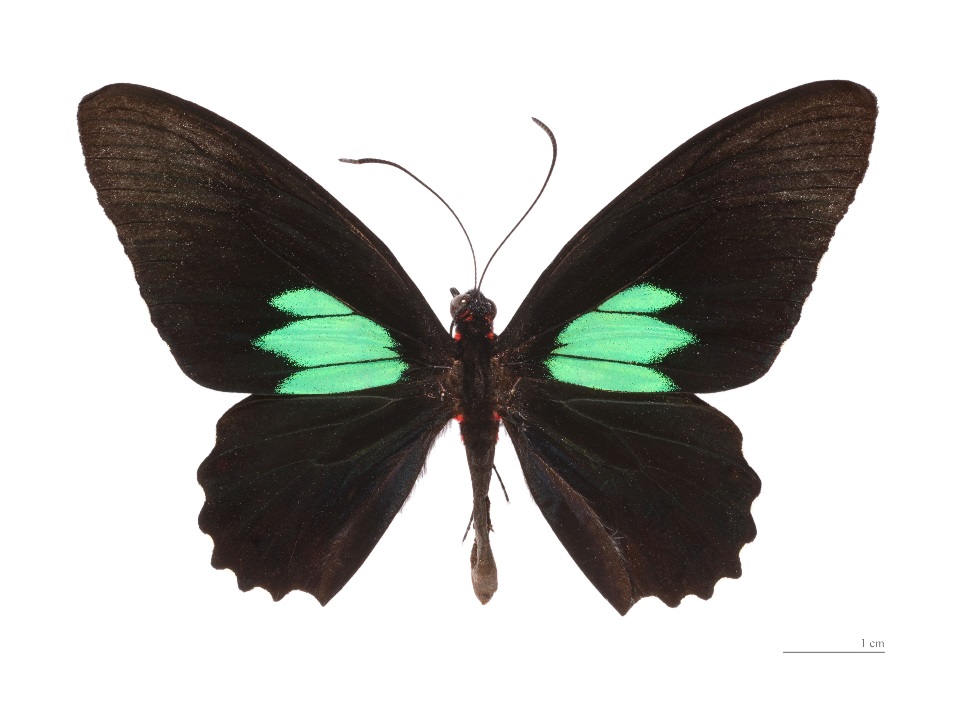
Emerald-patched Cattleheart butterfly
The Power of Interdisciplinary Science
Gerd’s journey has taught him the importance and the joys of interdisciplinary collaboration:
“Biology is a wonderful thing, even through the eyes of a physicist. But, in order to really unlock nature’s workings requires an interdisciplinary effort and team. That’s where the fun begins. And the challenges to make sure things don’t get lost in translation across discipline boundaries.”
As the project begins, Gerd reflects on the broader impact:
“This award enables us to push the boundaries of what we know about how nature builds functional structures at the nanoscale. It’s a privilege to be able to explore these questions with such a talented, international team.”
The implications of this research stretch beyond butterflies. Synthetic materials with geometries similar to the butterfly gyroid are being explored in the context of sustainable materials, drug delivery systems, and food technology. The butterfly gyroid structure is not only a marvel of natural engineering but also a potential blueprint for the next generation of human-made materials—combining function, efficiency, and beauty in ways that only nature, until now, has mastered.
Congratulations to Professor Gerd Schroeder-Turk and all collaborators on this exciting new chapter for the School of MSCP!
News
Murdoch Professor Wins ARC Grant to Explore Nature’s Nanotechnology
Posted on