
News
Business School Sprints shaping the next generation of Bushfire Innovators
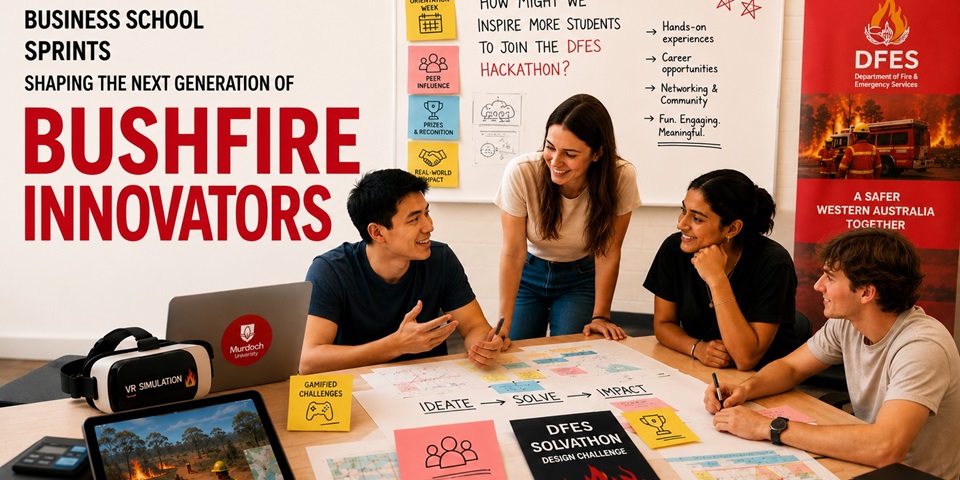
A new student insights report from the Murdoch Business School is offering a clear message for anyone looking to engage young people in solving real-world challenges: make it experiential, make it social, and make the value immediate.
As part of BUS109: The Innovator's Mindset, 29 first-year students took part in a design sprint aimed at inspiring the next generation of bushfire innovators to engage and collaborate with the Department of Fire and Emergency Services. Each student completed a client design challenge focused on enhancing student participation in a DFES-sponsored hackathon. Students had six weeks to develop their solutions, before meeting with the workshop facilitator to present and discuss their ideas. This process generated a diverse and innovative range of perspectives, which were collected, synthesised, and presented in a final report.
What emerged was a remarkably consistent set of recommendations. When interviewed by their lecturer, Dr. Simon Minaee, the first semester students said traditional presentations and institutional messages were unlikely to cut through with the younger generation. Instead, they suggested immersive, hands-on experiences such as VR simulations, gamified challenges, and collaborative problem-solving tasks that feel relevant, engaging, and real.
Timing also matters. Orientation Week was identified as the best opportunity to attract participation, when students are most open to new experiences and less burdened by assessment pressures. Just as importantly, students said messaging should focus on what they gain — career opportunities, recognition, prizes, networking, and social connection — rather than leading only with the importance of the cause.
Another strong finding was that peer influence matters more than formal promotion. Students said they are far more likely to respond to ambassadors, influencers, and word-of-mouth conversations than top-down university or agency communications.
One of the more revealing findings was that only a small number of students had a clear understanding of what a Hackathon or Solvathon was before taking on the challenge. However, rather than acting as a barrier, this highlighted an opportunity to design future initiatives which are accessible, clearly explained, and tailored to student interests, and help more students see how they can contribute to real-world problem-solving.
The report produced by Dr. Simon Minaee, which summarised the interviews and work of his students, suggested that a well-designed DFES Solvathon could do more than just generate ideas.
“It could build student awareness of bushfire risk, strengthen community understanding of planned burning, and create meaningful pathways for young people to contribute to one of Western Australia’s most important public challenges,” he said.News
Business School Sprints shaping the next generation of Bushfire Innovators
Posted on