News
Type 2 diabetes breakthrough nears human trial phase
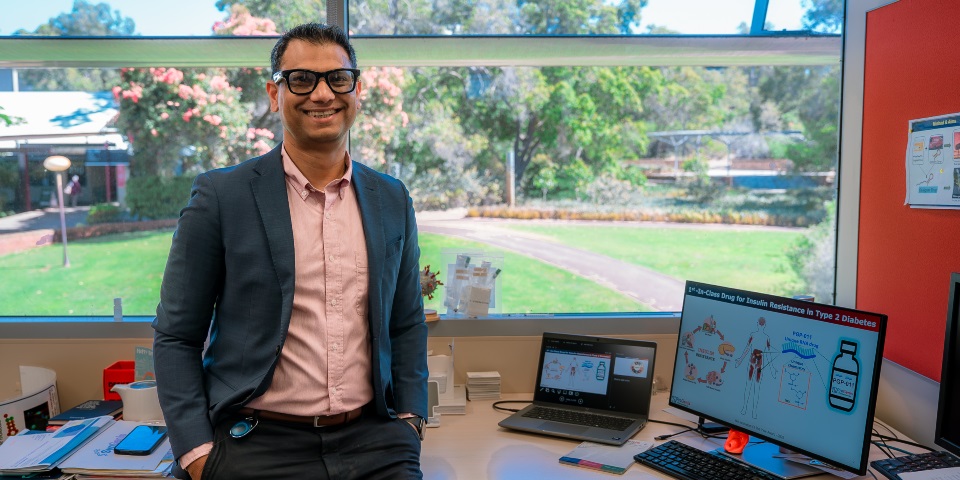
A small team of researchers at the Personalised Medicine Centre is working on a breakthrough that could reshape the treatment of type 2 diabetes.
At the helm is Professor Rakesh Veedu, a chemical biologist at Murdoch University and co-founder of the pharmaceutical startup ProGenis. His team is developing a new class of RNA-based medicines that target a root cause of type 2 diabetes: insulin resistance.
“Current treatments do not directly treat insulin signalling impairment to manage insulin resistance and high blood sugar,” Professor Veedu said.
Type 2 diabetes occurs when the body’s cells become resistant to insulin, the hormone that helps regulate blood sugar. Normally, insulin acts like a key, unlocking cells so glucose can enter and be used for energy.
But in people with insulin resistance, the key doesn’t work properly. The pancreas compensates by producing more insulin, but over time, this leads to elevated blood sugar levels and a cascade of health issues – from fatigue and nerve damage to heart disease.
Drugs currently used to treat diabetes – known as GLP-1 agonists – help lower blood sugar and promote insulin secretion, and weight loss, but they come with side effects, including muscle loss. This is particularly concerning for older adults.
“Our goal is to develop a therapy that’s not only more effective in addressing insulin resistance, but also safer and easier to use.”
The drug being developed by Murdoch University spinout company ProGenis – named PGP-011 – is composed of a novel RNA chemistry called thiomorpholinos (TMOs) and has been co-developed with American biochemist and ProGenis co-founder Professor Marvin Caruthers from the University of Colorado.
“RNA-based medicines with TMO chemistry offer significant promise for developing precision therapies to treat rare and acquired diseases,” Professor Veedu explained.
Unlike conventional approaches, ProGenis operates out of a dedicated custom built laboratory facility at Bentley Technology Park – the first of its kind for a pharma startup in Perth.
Professor Veedu and the ProGenis team are working closely with a Diabetes Consumer Advisory Group, who are actively advising on how the drug should be delivered, including the frequency and route of administration.
Next year, the team will begin trials in non-human primates, with clinical trials expected to start in late 2026.
With nearly 1.2 million Australians living with type 2 diabetes, the stakes are high. The disease costs the health system billions each year and affects quality of life for millions.
A drug that treats the root cause, rather than just the symptoms, would be a game-changer.
The Personalised Medicine Centre is a collaborative research centre between Murdoch University and the Perron Institute, where cutting-edge laboratory research and clinical expertise converge.
News
Type 2 diabetes breakthrough nears human trial phase
Posted on
Health Futures Institute
The many interlinked facets of human health, from understanding the genome and its variable expression, to disease surveillance, health data linkage, mental health and navigating life's milestones, intersect at the Health Futures Institute.Learn more about our research.