News
Plastic Free July: the scientists building a world beyond microplastics
.tmb-960-banner.jpg?Culture=en&sfvrsn=21abc85e_1)
Plastic Free July 2026 is an opportunity to shine a light on Murdoch University projects designed to help the world move away from microplastics.
In 2024, the University launched its Bioplastics Innovation Hub (BIH), a collaboration with CSIRO, with the purpose of bringing together scientists and industry to find a scalable alternative to single-use plastics.
Since its inception, the Hub has been a catalyst for innovation, working on solutions that span across several industries including agriculture, food service and packaging.
In 2025, a review from BIH scientist Joseph Boctor highlighted that agricultural soils now hold around 23 times more microplastics than oceans.
With traditional, single-use plastic unable to biodegrade, it is ending up making the journey from soil, to salad, to humans.
This is why the BIH is working to create different forms of bioplastics – which serve the same purpose as traditional plastics, without leaving behind any legacy in land, soil or water.
Greening the lucrative seafood business
Seafood is one of WA’s most lucrative industries – but in order to transport seafood from the ocean to the markets or shelves, it has historically been stored in expanded polystyrene boxes. These have now been banned in WA and are being phased out around the world.
While some greener, recyclable packaging options have been introduced, the BIH team is collaborating with Perth biotechnology company Cass Materials to move from recyclable to fully biodegradable.
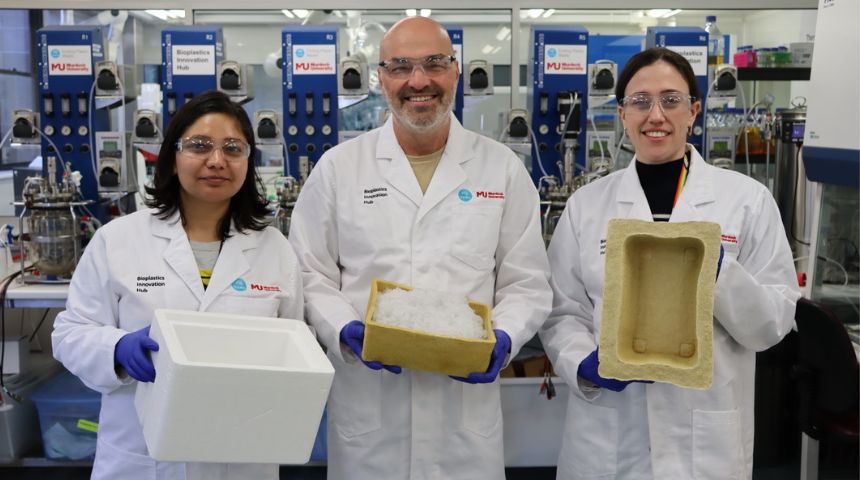
Using excess wheat straw from farms which would otherwise be burnt, the team has developed biofoam seafood boxes – transforming agricultural waste into a fossil-free plastic alternative.
The biofoam boxes are currently at TLR4, meaning the laboratory prototypes have been validated.
While Cass Materials raises capital to scale this technology, BIH researchers are developing the entirely waterproof barrier needed to meet final requirements.
Innovative inventions
Researchers from the BIH have used bioplastics to create innovative technologies to support sustainability and environmental health.
In collaboration with Walailak University, researchers developed 3D printed bioplastic pods to protect newly planted seagrass shoots in Thailand.
These seagrass meadows provide not only habitat for shrimp, crab and fish which sustain local communities, but also a food source for Thailand’s declining dugong population.
.jpg?sfvrsn=e92b6ac5_1 "Biodegradable seagrass pods")
As WA’s climate gets hotter and drier, farmers are battling to save their crops.
In response, researchers have visited farms across the State to demonstrate a biodegradable polymer spray capable of capturing and redirecting water to crop seeds.
The SMART SPRAYS, Maximising the Benefits from Rainfall project, led by BIH Director Professor Daniel Murphy, aims to develop a commercially viable concept over the next few years.
This could be the key to drought-proofing farms.
The power of bacteria and enzymes
Breakthrough research from the BIH this year revealed the full genetic code of bacteria from the salt lakes of Wadjemup (Rottnest Island), providing the clearest picture yet of how the organisms could be used to make biodegradable plastic.
The bacteria, Salinvibrio, grow fast, thrive in salty water and naturally make a plastic called PHA, which breaks down naturally.
Having the full genetic code allows scientists to point to the exact genes which can make plastic – giving them a strong foundation to build on and fine-tune.
While researchers from the BIH are working on building bioplastics, they are also finding bacteria and enzymes which can break down existing plastic waste.
.jpg?sfvrsn=8f9e0809_1 "Inside the Bioplastics Innovation Hub at Murdoch University.")
This research explores safe methods of breaking down existing plastic waste which has made its way into waterways around the world.
One research project is assessing the ability of the Greater Wax Moth to eat and use fossil-based plastics as energy sources.
These are just a few examples of the ways in which our scientists are channelling research efforts into beating the plastic waste crisis.
News
Plastic Free July: the scientists building a world beyond microplastics
Posted on
Topics