News
Biofoam boxes greening WA’s lucrative seafood industry
Western Australia is known for many things – from its beautiful beaches to its vast outback, and, famously, its fresh and tasty seafood.
The WA seafood industry brings in around $1billion of revenue each year, making it one of the state’s most lucrative industries. However, with that revenue comes packaging waste.
To transport seafood from the ocean to the markets or the shelves, it has historically been stored in expanded polystyrene boxes. These have now been banned in WA and are being phased out around the world.
While some greener, recyclable packaging options have been introduced, a new and collaborative local project is looking to move from recyclable, to fully biodegradable.
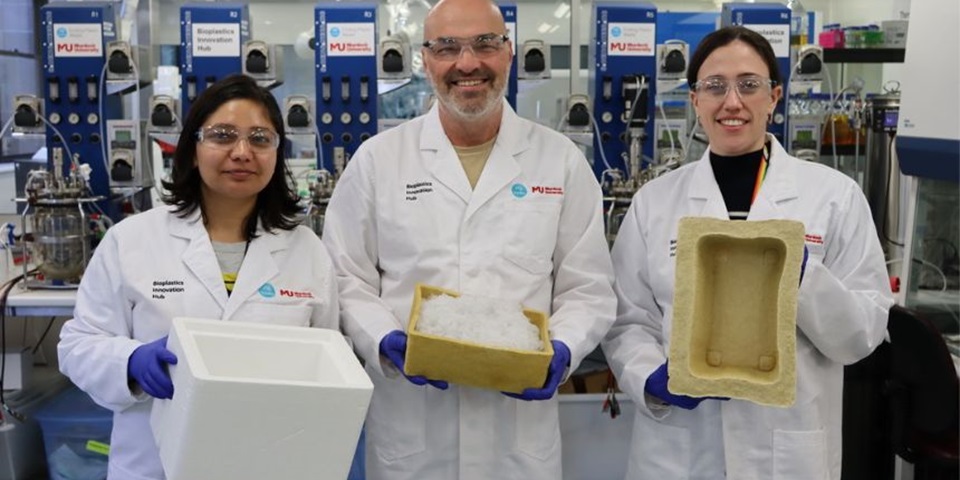
The Bioplastics Innovation Hub (BIH), a joint venture between Murdoch University and CSIRO, has partnered with Cass Materials, a Perth biotechnology company, to develop biofoam seafood boxes made from wheat straw.
“In WA, approximately 10million tonnes of wheat straw per year is retained on the farm and, with no tillage systems, most is burnt,” Cass Materials CEO Gary Cass said.
“With the Bioplastics Innovation Hub, we can convert this agricultural waste into new fossil-free biofoam boxes for fresh food and seafood markets.”
Traditional polystyrene boxes take more than 500 years to decompose in landfill, and form microplastics as they break down.
Biofoam boxes fully break down within a few months and improve the organic matter content of soils.
This is particularly poignant, as a recent review by Murdoch University discovered that agricultural soils now hold around 23 times more microplastics than oceans.
The boxes are also lightweight, hydrophobic (able to retain ice and water) and home compostable.
BIH director Professor Dan Murphy said the Hub’s research is directed by what industry needs and aims to solve real-world problems.
“We want to improve single use items in the food industry by having biodegradable and compostable materials that replace things like synthetic plastics,” Professor Murphy said.
By developing these items that can replace synthetic plastic in food transportation, storage and packaging we can help to both lower environmental impacts and address incoming plastic bans.
The biofoam boxes are currently at TRL4, meaning the laboratory prototypes have been validated. Cass Materials is currently raising capital to scale this technology.
In preparation for this upscale, BIH researchers are working to develop the entirely waterproof barrier needed to meet final requirements.
“We are confident that upon scaling-up this product, it will become a commercial success and meet the consumer and industry demand for convenient and environmentally friendly packaging.”
Mr Cass said there was an increase in demand from consumers for greener products, and that it was imperative for industry to make products that were both green and economically viable.
“Consumers are becoming more aware of the damage that fossil-based plastics are doing to our environment,” he said.
“With this awareness, they are seeking out these sustainable alternatives.”
Want to be a part of greening our future? Find out about our School of Environmental and Conservation Sciences.
News
Biofoam boxes greening WA’s lucrative seafood industry
Posted on