News
Human hair could hold the key to solving cold cases
Murdoch University researchers have helped win the WA Government Innovator of the Year Award, with a novel forensic technique which may have the power to unlock cold cases.
The award, won by ChemCentre and PathWest Forensic Biology, was announced at the 19th annual WA Innovators of the Year ceremony by WA Medical Research, Science and Innovation Minister Stephen Dawson.
The project’s aim is to create a new forensic capability in Western Australia by using proteins in human hair to identify individuals when DNA evidence is insufficient.
Traditionally, DNA analysis has been the gold standard for forensic identification, but hair shafts often lack enough DNA for reliable testing. This innovative approach leverages the protein variants in a single hair strand to infer genetic information, creating a powerful new tool for forensic science, especially in cold cases where other opportunities have dried up.
The project is led by ChemCentre in collaboration with PathWest, WA Police, Murdoch University, Edith Cowan University, and an international team from the University of California, Davis
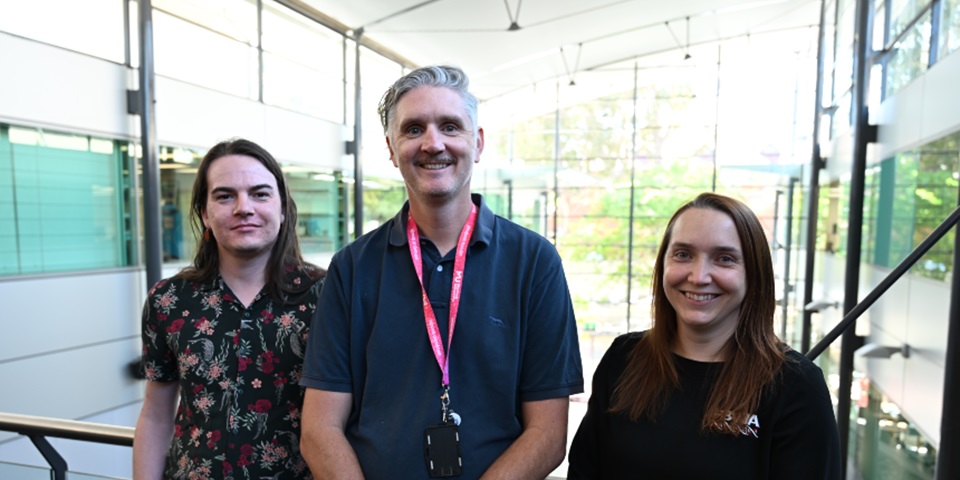
Murdoch University’s Associate Professor Brendan Chapman, Dr Marie Rye and PhD candidate Aaron Hamilton played a pivotal role in the research, by generating human DNA data for the project which was cross referenced with protein peptide sequences.
Dr Rye holds an academic position within the School of Medical, Molecular and Forensic Sciences and is the team leader of the PathWest Forensic Biology Research & Development team.
Associate Professor Chapman lauded the achievement as a demonstration of the translational research that can be accomplished through collaboration with industry.
“This award highlights the power of collaboration and innovation in forensic science,” he said.
“It grew out of discussions with ChemCentre and UC- Davis colleagues back in 2018 and is now a four and a half million-dollar multi-agency undertaking that will deliver real criminal justice outcomes."
The research will now undergo an internationally accredited forensic process that will provide robust, objective analysis of single hair shafts for evidential and investigative purposes.