Blog
Model Patients
.tmb-960-banner.png?Culture=en&sfvrsn=754cd301_1 "Untitled design (4)")
Murdoch University’s Clinical Skills Laboratory is transforming Veterinary Training
Among the corridors of the Veterinary Medicine School at Murdoch University lies a discreet, forward thinking training space. It’s not filled with the usual sounds of barking dogs or anxious owners, but with the quiet hum of silicon lungs inflating, haptic sensors buzzing, and students quietly practicing their skills on life-like animal models. Here, students don’t just read about veterinary medicine - they feel it.
“The Murdoch Clinical Skills Laboratory bridges the gap between theory and live animal handling,” says Dr Annett Annandale, the academic and driving force behind the lab’s development. “It allows students to gain confidence and competence before performing procedures on a real animal.”
Historically, veterinary students were taught using live animals, even for invasive techniques. But worldwide growing concerns about animal welfare, increasing student numbers, and the rising costs of maintaining live teaching animals have driven a dramatic change in approach over the last few decades.
“In the past, everything was done on live animals—drawing blood, placing catheters, giving injections,” Annett explained. “That’s just not acceptable anymore, ethically or practically.”
Today, Murdoch University’s lab is filled with custom-made and commercially designed simulators. It includes dogs that can be intubated, cats used for intravenous access, birds suitable for wing bandaging, and even sheep and cows with interchangeable internal organs. The models are specifically crafted to give veterinary students the skillsets they will need when working in the field with both companion and production animals.
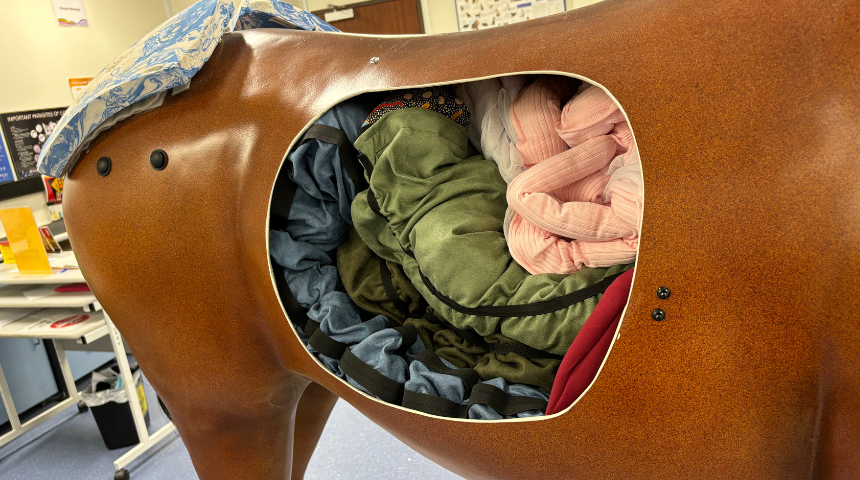
Modified fiberglass horse enhanced with a live-sized colour-coded fabric gastrointestinal tract to simulate topographic anatomy and colic scenarios.
One of the major strengths of the Clinical Skills Laboratory lies in its ability to offer repeated, self-paced practice.
“Not everyone learns at the same speed,” Annett says. “Some students get it the first time. Others need to do it twenty times. The lab gives them that space, privately, to learn without pressure.”
In Murdoch University’s veterinary science degree students traditionally move from theory lessons and videos to hands-on practice with models, before transitioning to live animals under close supervision. The process ensures they’re not only safe and competent, but confident.
Take the example of bovine transrectal palpation, which is a veterinary procedure used primarily for pregnancy diagnosis in cattle. It is an essential but notoriously difficult skill.
“It used to be just lecture and abattoir organ exposure - then a real cow, said Dr Annandale. “Now, it starts with a lecture, followed by abattoir organ as well as simulator and model practice. Students must pass a formative assessment on a model before moving to live animals. They can practice as many times as needed and sign up for the assessment when they feel ready. Then, we schedule the live cow palpation sessions on the Murdoch farm. This way we ensure students have basic palpations skills and are optimally prepared for the live animal exposure”
Many of the lab’s models are designed in-house or adapted from hardware store materials.
“Commercial large-animal models can be incredibly expensive and are not always well-designed for teaching, so sometimes we just make our own,” she said.
With help from her colleague Sumithra Kersenerrnayer (RVN), who manages logistics, schedules, and produces silicone molds, they build and refine models that simulate everything from difficult lambing births to abdominal surgeries.
With regard to our beloved cats and dogs, the veterinary students have models that enable them to practice IV access, intubation, setting up anaesthesia, CPR, blood pressure, blood smears, bandaging, and suturing. Some of the models even make sounds or mimic complications.
The Clinical Skills Lab is also incorporating virtual reality, such as a cattle-handling simulation where students learn how to safely position themselves safely around large animals. Another project, co-developed with IT students, replicates equine x-ray positioning in VR to teach image quality, safety, and equipment placement without the risks, or costs to live animals.
a3913b27-8442-4ab9-ad3c-e84baeb8ff0c.png?sfvrsn=9c279f59_1 "Untitled design (4)")
Dr Annandale demonstrating the Haptic Cow Simulator, a virtual reality-based training tool to enhance transrectal examination skills.
Murdoch University’s Clinical Skills Lab has a national profile with all the veterinary schools around Australia pooling knowledge and sharing their experiences with models, both purchased and created. The demand in this field is growing rapidly, both for the skill potential and the educational philosophy behind them.
When asked what model she’d acquire with unlimited funds, Dr Annandale had no hesitation in selecting a $100,000 dystocia cow model from Canada, which would allow students to practice complicated calf deliveries using a full-sized 35kg artificial calf.
"We use abattoir calves now, but they can only be used once, without repeat practice opportunities for students and we have to keep biosecurity risks in mind when using them " she said.
Although only around 15% of students plan to work in large animal practice, Dr Annandale believes that early and meaningful exposure to these fields may inspire more to consider them, especially given the critical vet shortage in rural and agricultural sectors.
“In one unit, I recorded a welcome video saying, ‘I know most of you aren’t looking to work with production animals, but just engage with the models,’” she recalls. The result was that over 90% of the class signed up for optional cattle and VR sessions. “Even students who came in scared of cows ended up coming back for more!” she added.
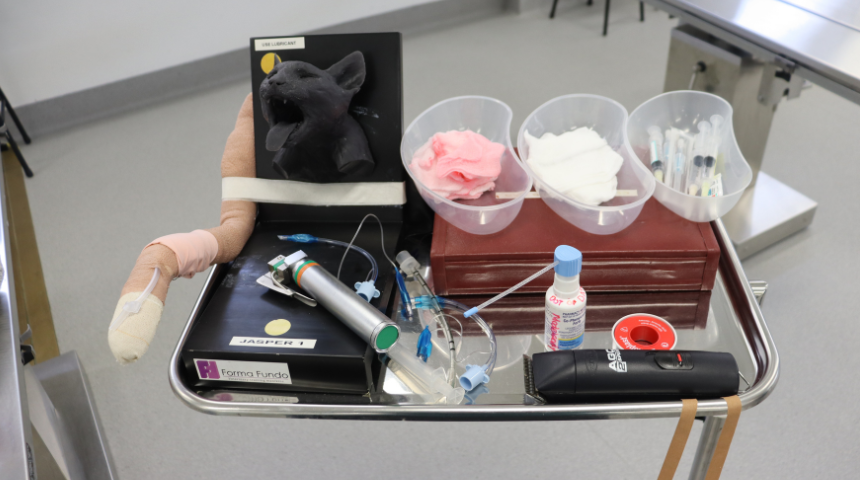
Cat intubation manikin to practice anaesthetic skills paired with items and instruments required for intravenous catherization and endotracheal intubation.
Ultimately, veterinary graduates aren’t registered as ‘small animal’ or ‘equine’ vets. They’re expected to have broad day-one competencies across species. So, while they may learn a skill that they are likely to be doing regularly, such as cat spaying, they are also given opportunities to develop broad skills such as bandaging a bird’s wing, diagnosing pregnancy in an ewe, or palpating a model cow’s abdomen.
It may soon need to move to bigger premises but until then, Murdoch University’s Clinical Skills Lab will continue with its vital role in helping graduates emerge with a formidable range of experience while keeping animals safer in the process.
Click HERE if you would like to learn more about how you can support and invest in the future of veterinary medicine through the Clinical skills lab.
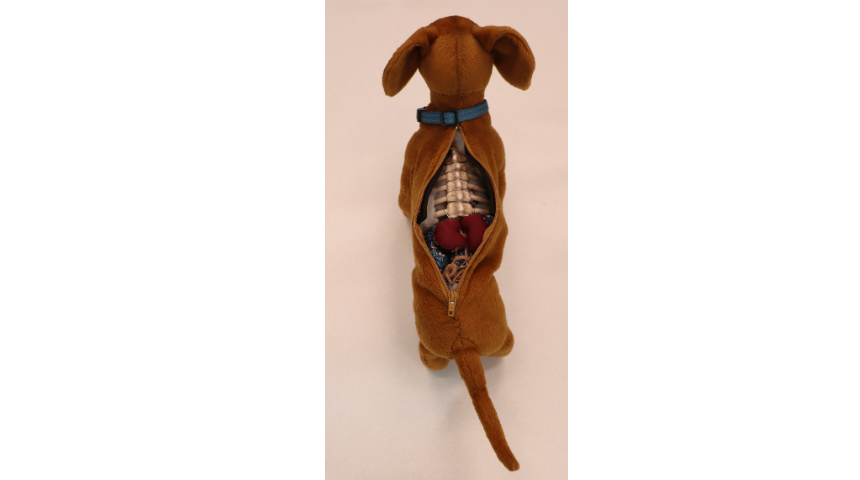
Mini Dachsund manikin modified to serve as abdominal palpation model.
Feature Pic: Fourth year veterinary students getting ready to operate on dog ovariohysterectomy models in a simulated spey clinic setting.
Blog
Model Patients
Posted on
Tuesday 12 August 2025
Topics