Blog
Guiding Hands in Veterinary Surgery
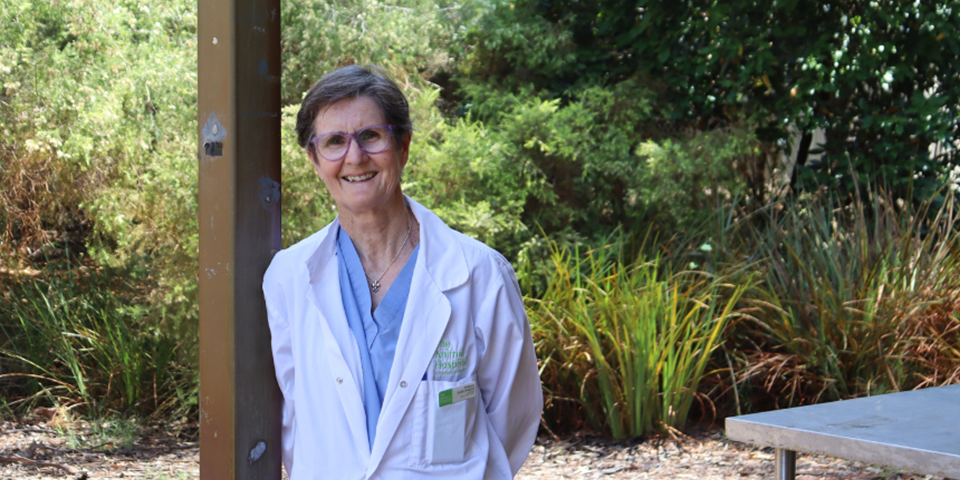
The prestigious Murdoch University Senate Medal was recently awarded to Professor Giselle Hosgood for her outstanding contributions to veterinary surgery, research, and education.
Her leadership extends beyond the classroom, with initiatives that uphold animal welfare and ethics, such as the annual memorial event honouring animals’ roles in education.
With over 280 publications and global recognition in soft tissue and oncologic surgery, Giselle has elevated Murdoch’s reputation for excellence. Her mentorship has guided more than 40 residents and 45 graduate students, inspiring future veterinary professionals. With an elite career stretching from Australia to the United States, Giselle has shaped her profession and inspired countless veterinary students under her tutelage. We caught up to find out a little more about her career in veterinary surgery and some of the changes she has witnessed...
When did you realise you wanted to become a vet?
It’s a cliché answer, but I remember telling my grandmother when I was 10 that I wanted to be a vet. I don’t really know where it came from. Some of my family were on farms, and I enjoyed that environment, so perhaps that’s where it started. I kept that idea in my head the whole time. I had a brief moment where I considered being an architect, but I always returned to wanting to be a vet.
Are you happy with the decision you made?
Yes, I think it was a good decision. The profession has been good to me. There are challenges, and the profession has changed. My pathway has been quite different to someone who graduates and simply goes into practice. If I had done only that, I think I would have become bored.
What was your undergraduate qualification?
I did a Bachelor of Biological Science (BBSc) at the University of Queensland, then came to Murdoch for two years as an intern in small animal surgery. After that, I went to the United States to pursue a residency in small animal surgery because at that time there were very few opportunities for specialty training in Australia or Europe. America was far more advanced in that area. I went there in 1985 and stayed for 24 years.
Was that at Baton Rouge?
I went to Purdue University in Indiana first, then moved to Louisiana State University in Baton Rouge for 20 years.
So, you knew as soon as you got your first veterinary qualification that you didn’t want to be a small-animal practice vet?
Around the third year of vet school, I became exposed to, and really enjoyed, surgery. I started working towards pursuing that more seriously. The Murdoch internship gave me two years of more intensive surgical exposure and made me a better candidate for further training.
So small-animal soft-tissue surgery is your speciality?
During the training process, you cover all aspects of surgery - orthopaedics, neurosurgery, oncology, soft tissue etc. The certifying exams test you in all areas. But when you become a practicing specialist, people gravitate to one field. You can’t be a jack-of-all-trades; the disciplines are too different and too detailed. In an academic environment especially, you tend to specialise more deeply.
And you’ve managed to balance surgery, research, and teaching?
Yes. It has been quite a heavy load. The American academic system is more intense than the Australian one, and there’s a constant pressure to maintain that intensity to progress through the ranks.
You’ve been working since the mid-80s. What major changes have there been in veterinary surgery?
There have been many technical developments - new suture materials, antibiotics, equipment, improved diagnostics. People are also willing to spend more on their pets, and insurance plays a role. Expectations have increased alongside what we can deliver. There have been massive changes, although change can also be slow. Parts of the profession embrace it quickly; others remain a bit stuck.
Why is that?
Specialisation in veterinary medicine is not overseen by the Australian Veterinary Association; they oversee undergraduate and professional programs. The two realms aren’t always aligned. There’s still this idea that we must produce an “omni-species, omni-discipline” veterinarian who can do everything, which is unrealistic. It slows the embrace of specialisation. There’s still a bit of ‘James Herriot nostalgia’ in the profession.
Has there been an innovation in surgery that you think really shaped the field?
Imaging - CT, MRI etc. has probably made the greatest difference. It allows us to detect and characterise disease far better and plan around it. The old approach of “the dog has something wrong, let’s open the abdomen and see” is outdated and harmful. Now we determine what’s going on first, decide if surgery is appropriate, and plan exactly what we’ll do before making the first cut. Better information has transformed our ability to deliver care.
What type of clinical case challenges you the most?
I’ve developed various techniques throughout my career, and I’ve always been interested in wound management and reconstruction. The challenge is achieving a good functional outcome. Often, I receive cases where someone else has attempted treatment unsuccessfully, or cases no one else wants because they’re very difficult. That’s where the challenge lies.
What makes those cases hard?
Advanced disease, technical difficulty, or the need to salvage a situation after an unsuccessful prior attempt. Those factors make cases more complex.
There must be a crossroads of decisions when dealing with an advanced disease in a companion animal—economics, ethics, whether surgery is right…
Yes, and it’s something students struggle with. The emotional side of the profession is challenging. Much of the stress stems from emotional pressure: your own emotions, owners’ emotions, and the emotional blackmail that can occur. “If you loved animals, you’d do this for free.” I tell them to try that on their plumber!
You need to discuss finances with owners and help them make clear decisions. I try to keep it simple: either we do something or we don’t. I know the outcome of doing nothing. If the owner has the resources and the proposed treatment offers a reasonable outcome, then that’s the path.
The public often isn’t aware of the cost structures, are they?
No. An owner hears that a CT costs $2,000 and says, “I had a CT last week and it didn’t cost me anything.” Well, the taxpayer paid for it. Veterinary hospitals have to buy the machine, pay for service contracts etc. People often don’t appreciate that.
Age also gets thrown in - “He’s 10, I don’t know how long he’ll live.” Well, if you do nothing, he’ll still be 10 tomorrow, and you’ll have done nothing. Often age is an excuse for not wanting to treat. You have to sidestep that to avoid getting stuck.
There’s a lot of stress and trauma in that decision-making. It must be hard to manage over a long career?
My resilience after 40-plus years hasn’t been exhausted by the emotional side; I can still handle that. What exhausts me is complaints -people who are unappreciative or have unreasonable expectations. That has become more common. It doesn’t matter what field you’re in; the general public can be rude, and that wears you down.
There was a young vet who took her own life, and her parents said she was always terrified of complaints to the Veterinary Surgeons Board and losing her licence. You live under that threat, not for mistakes, but for things owners simply aren’t happy about.
In 24 years in America, supposedly the most litigious country in the world, I had maybe half a dozen issues, none of which ever went to the board. In 17 years back in Australia, I’ve had multiple cases, often ridiculous, but they take a heavy emotional toll. That’s the real pressure.
Many young people say, “I love animals” as their reason for becoming vets.
Exactly. In admissions interviews, when someone says, “I love animals,” I sometimes suggest perhaps they should be a conservationist. Being a vet is not the right profession if that’s your sole motivation. Half of what you do is dealing with people, and love of animals alone can’t carry you through.
How do you help students build confidence when learning surgical skills?
I encourage them to interact and ask questions. It’s about understanding why you’re doing something, not just how. They might watch someone suture and then copy it, but the important part is understanding technique: how you hold the instrument, why you place a suture in a particular way.
I always say you can train a monkey to spay a dog, but does he understand why he’s doing each step? If something varies from the norm, you can’t adapt unless you understand the principles. I want students to observe critically and ask - “Why did I do that?” rather than simply watching and walking away.
You’ve had a vast career. Are there research areas that have been especially meaningful to you?
Most of my research is clinically driven - modifying techniques, improving outcomes, or questioning why we see what we see. The projects I’m proudest of are those that have changed the way we do things: techniques I’ve developed or improved understanding of particular processes.
Does that usually begin with realising that the standard technique isn’t working well?
Often, yes. You’re doing something and think, “This isn’t right, there must be a better way.” Residents often bring research ideas to me, and I help them refine the question. You have to start with understanding the basic process before jumping too far ahead. Many advances come from looking at a clinical problem differently.
And I think surgeons, especially left-handed ones like myself, tend to be a bit creative; you need that to solve problems.
What advice would you give to a veterinarian considering a surgical specialty?
There are many specialties, and surgery is competitive. There are limited training opportunities in Australia, more in the US and Europe. You need to think about it early. You can’t spend 10 years in general practice and then decide to become a surgeon. Your skills won’t be precise enough, and you’ll be far removed from current knowledge.
You need to get involved in the specialty environment early - do internships, find good mentors, start engaging with research. You must pay your dues, start at the bottom, and invest fully in the process.
Do you need a good mentor?
Yes. Good mentorship helps you use your time wisely, gain the right experiences, and position yourself to be competitive for training.
When you meet veterinary surgeons from around the world, do you see common characteristics?
Definitely. Different disciplines attract different personalities. Internal medicine people and surgeons are completely different. Surgeons need to be definitive, decisive, and act quickly with a no-nonsense approach. Medicine is slower, reflective, and comfortable with pondering and gathering more information. That contrast can be frustrating when co-managing cases - surgeons want to operate, medicine wants to “fluff around” a bit. So yes, personality differences between disciplines are there.
You’ve juggled research, teaching, and surgery over your career. Has it been a good blend?
I think so. Research and surgery have been more rewarding to me than teaching, but over time, as you become more confident, teaching becomes more enjoyable. We’re not trained as teachers, we are trained as veterinarians, so it takes time to learn how to teach effectively and manage students’ expectations.
Looking back, what impact do you hope you’ve had on the profession?
I know I’ve changed lives—owners’ lives through helping their animals, and residents’ lives through training. I’ve invested a lot in my residents, and I like to think I’ve had a lasting influence.
I’ve always been passionate about the profession and wanted to make it better. We always need to move forward, and I hope I’ve helped push the profession in that direction.
Blog
Guiding Hands in Veterinary Surgery
Posted on
Wednesday 17 December 2025
Topics