Blog
The teacher protecting curiosity in the classroom
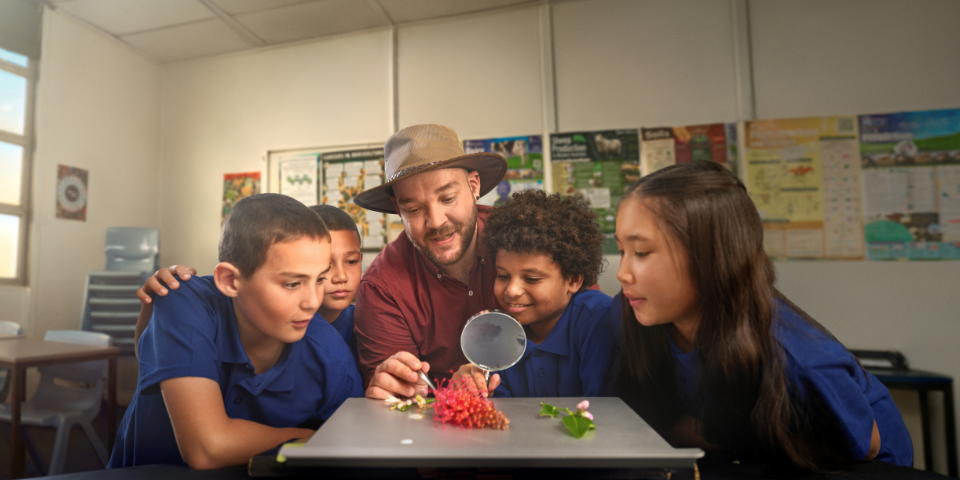
As students arrive at Kelmscott Senior High School each morning, Jason Pitman pays attention to how they enter the day – who moves easily, who hangs back, who might need a quiet word before the day begins. For him, teaching starts well before the lesson does.
That attentiveness is shaped by memory.
"I didn't always feel safe enough to be myself at school," Jason said, reflecting on his own high school experience when there was not as much attention to inclusivity as there is today.
"I would hate for any student to feel like that in my classroom."
So, he teaches with care built in, creating space for students to speak, be seen, and bring their whole selves into the room. Even when they might not yet have the words for it.
Teaching came later in life for Jason, encouraged by people he worked alongside during an earlier career in biodiversity and conservation.
After studying environmental management at Murdoch University, he worked across sustainability roles, including at the World Wildlife Fund and the Botanic Gardens and Parks Authority.
In those roles people around him noticed the same thing: his patience, his curiosity, and the way he explained things without diminishing others.
His colleagues began saying, again and again, "You'd be a great teacher."
He wasn't sure at first. Then he took a job in science communication at the Western Australian Museum – and something clicked.
"That's where I fell in love with learning," he said.
One day at the museum, Jason spoke with a child about Carnaby's cockatoos – their declining numbers, what was happening to their habitat, and why it mattered. The child listened politely. But months later it was the child's father who returned.
"He came back and said he'd gone home and put up cockatoo nest boxes," Jason recalled.
"That's when I realised that education is not just a tool for kids – it moves through families."
This was the moment of inspiration that led him back to Murdoch University to study secondary education.
Jason reflects that it was here that he first learned what a supportive learning environment actually looked like after arriving as a first‑in‑family student.
"The tutors and all my fellow students were really welcoming, and admin staff were amazing," he said.
You got this feeling of community, and I think that's what brought me back for my second degree.
Today, he teaches agriculture, science and maths to Years 7–10, where he brings his deep environmental knowledge and life experience to create a learning environment focused on curiosity and care.
Teenagers, he says, often face a period when curiosity collapses as friendships, identity, pressure, and self‑doubt take hold. School can become the place they decide what they're "not".
"In primary school, kids are natural discoverers," he said. "But when you hit high school, that disengagement happens… and having a teacher that cares, and wants you to succeed, can really make the difference."
A big part of that is helping students to really understand what the knowledge is for.
"I always try to bring it back to real world experiences and demonstrate what the impact is from their learning – and a lot of the time that means going outside," he said.
"So, for example, if we're looking at flowers we'll go out and dissect orange blossoms and talk about how we don't just need the flowers for the fruit, but how they are part of the system that underpins everything."
Sometimes he even lets students lead, as proof that they can contribute to something bigger. When he attended a biodiversity conference recently, he invited his students to develop the presentation.
It's a small but significant gesture – giving students a platform and showing that what they have to say is worth carrying beyond the classroom.
"I think teachers are very powerful in amplifying the voices of young people who sometimes feel voiceless."
Care for him is also about creating safety. He is open about who he is, not to make a point, but to normalise it. If he can be himself, students can too.
Years later, when asked what he'd say to future students who want careers that make a difference, he doesn't offer certainty or slogans. He says something simpler, and harder: Don't be afraid to show that you care.
I think if you want to make change, then you need to be looking for places that enable you to show that you care. And Murdoch did that. Murdoch did that for me.
Years later, care remains central to his work.
It's part of his teaching practice, built in small decisions, repeated until a classroom becomes the kind of place where a student feels safe enough to quietly say, "I care too."
Blog
The teacher protecting curiosity in the classroom
Posted on
Thursday 28 May 2026
Topics