Blog
The researcher saving lambs and supporting farmers
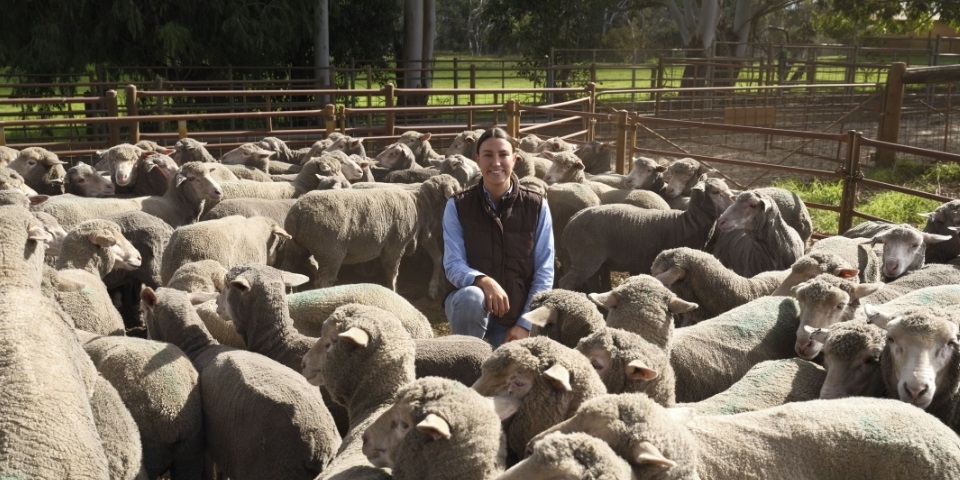
Georgia Welsh never planned a life in agriculture. A self‑described city girl, she arrived at Murdoch University intending to become a veterinarian.
What she found instead was a calling – one that would lead her from lecture theatres into paddocks, and from caring about animals to caring for entire farming systems.
I never thought I'd work in agriculture. It’s 100% because of my degree at Murdoch and the inspiring people and projects that I’ve been exposed to here.
Now in the fourth year of her PhD at Murdoch University, Georgia’s research focuses on one of the sheep industry’s most pressing challenges: improving lamb survival.
As part of the Edible Shelter Project, she is investigating whether lambing in paddocks with shrubs or crops – rather than exposed pasture –to provide greater protection can reduce lamb deaths caused by cold, wind and rain.
“Lamb survival is a priority for farmers,” Georgia said. “It’s not just a production issue – it’s animal welfare, and it matters deeply to the people who work with livestock every day.”
A central part of her work is running trials on farms across Australia, working directly with producers during lambing – often the mosta stressful time of year.
The goal is practical, evidence‑based guidance that farmers can realistically adopt: how paddock design, shelter orientation and crop grazing can improve survival without adding a burden.
“At the end of the day, every extra lamb that survives is a gain for the farmer, and a step forward for animal welfare.”
Although Georgia now lives on a farm, her pathway into agriculture wasn’t obvious.
She enrolled in Animal Science at Murdoch with the idea of moving into veterinary medicine, unaware of the agricultural careers available. That began to change during her undergraduate farm placements, where eight weeks of hands‑on work as an 18-year-old proved formative.
“It was the practical experience that hooked me,” Georgia said. “The work was physically hard, mentally challenging, and incredibly rewarding. I loved it.”
One placement, working with a farming family near Williams, left a lasting impression. There she saw for the first time the care farmers have for their animals.
“The farmer had thousands of cattle, but when one had to be put down, it broke his heart,” she recalled. “That changed how I saw the industry.”
That understanding now shapes how she approaches research and relationships. Much of Georgia’s work involves building trust with farmers – many older, experienced producers navigating tough seasons marked by drought, volatile prices and policy change.
“I never go in pretending I know everything. I listen, I respect their knowledge, and I acknowledge that I’m asking for their time during really busy periods.”
Those relationships aren’t always instant, but many grow to become long‑term.
“These aren’t transactional interactions,” she said. “I stay in touch. We trouble‑shoot together. Without those farmers, my research wouldn’t exist.”
Mentorship has been central to Georgia’s journey – especially her relationship with Associate Professor Serina Hancock.
“Serina has been in my corner from the very start. She’s pushed me to back myself, to apply for opportunities, to get out of my comfort zone.”
Through Serina’s guidance – and support from other senior researchers at Murdoch – Georgia has presented at industry forums, collaborated with CSIRO and UWA, and grown into a confident researcher embedded in the agricultural community.
The care shown by Murdoch staff isn’t just about being supportive. It’s about pushing you to be better – to be employable, capable, and confident in industry spaces.
Living regionally has only deepened Georgia’s commitment. Experiencing first hand how farming communities absorb shocks – weather, markets, policy – has reinforced the importance of research that delivers real‑world outcomes.
“I don’t want to research something that sits on a shelf,” she said. “I want work that improves productivity, welfare and sustainability on farm.”
At the end of her PhD, that’s what she hopes to leave behind: clear, practical evidence farmers can use to make better decisions. It’s this practicality that sees her research being funded by Meat and Livestock Australia and the WA Agricultural Research Collaboration.
Looking ahead, Georigia is mentoring others in the space and is passionate about encouraging more people to consider agriculture as a career.
“We need more young people in ag – especially women,” she said.
“If you want a career with real purpose, where you know you’re feeding people and caring for animals, agriculture has so much to offer.”
The next generation only need to look to her for proof: a young woman poised to deliver lasting impact for animals, farmers and the communities that depend on them.
Blog
The researcher saving lambs and supporting farmers
Posted on
Friday 3 July 2026