Blog
The problem-solver redesigning how care actually works
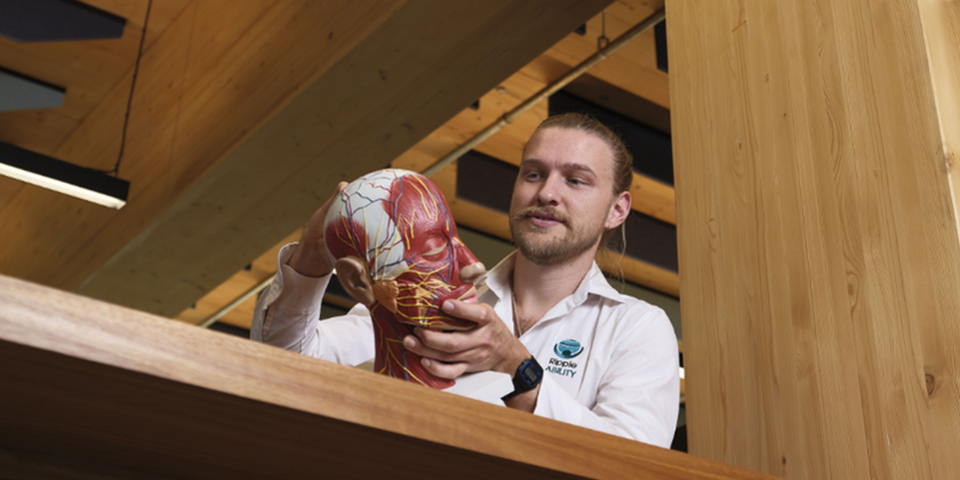
James Norton spends his days working on problems most people never see – gaps in disability support, policy blind spots, and services that don’t quite fit the realities of family life. At RippleAbility, his role is to help close those gaps.
It’s work shaped by a deep commitment to doing things properly.
RippleAbility is a service that helps families caring for children with disability and his work spans communications, research, policy advice and systems design. He speaks to government, healthcare providers and parents and carers – often acting as a translator between worlds that don’t always align.
"We're a navigational service, so we work with families to help them navigate their disability journey on behalf of their children,” he said.
"The earlier you get them supported, the better their outcomes are.”
It’s a place where his skills, values and lived experience have converged – and one he never expected to find himself in.
James came to university later than most, enrolling at Murdoch University as a mature‑age student after leaving school early and pursuing vocational training.
Hospitality gave him a strong grounding in people, pressure and responsibility, but it was psychology that gave him the tools to think deeply about behaviour, systems and evidence.
“I didn’t go into psychology casually,” he said. “I had a very clear why. I wanted to understand people properly.”
Murdoch stood out for its progressive approach. Where other programs felt fixed, Murdoch’s psychology discipline encouraged critical thinking and boundary‑pushing. James encountered academics who challenged assumptions and expected precision.
What I really liked about Murdoch was that there were academics who were willing to push the boundaries on what was being discussed in the space.
That expectation intensified in his fourth year, where he completed an honours thesis under the supervision of Dr David Lewis. Nothing went unexamined.
“There was no such thing as a passing comment,” James said. “If you said something, you had to back it up.”
His thesis examined why communities differed so widely in adherence to public‑health measures. The work was later published internationally.
“That was when it clicked,” James said. “University research isn’t theoretical. It’s real. Even as a student you’re contributing to knowledge that shapes the world.”
The same discipline he developed as a student would soon become central to his professional work.
After graduating, James took an intentional pause to travel before arriving home to join the newly formed RippleAbility. Originally brought on to help with design work, he became the organisation’s lead problem‑solver, applying research discipline to complex policy and service design challenges.
One of the most significant projects he has been involved in is an Australia‑first respite care pilot for families of children with complex medical needs.
The idea emerged from a moment of clarity: families bringing medically fragile children to a funeral because there was nowhere safe to leave them in care, even briefly.
“There was this overwhelming message,” James recalled. “We would love to be here without our children – but there is no alternative.”
What followed was five years of research, consultation and persistence. James led systematic reviews of local and international models, discovering that while similar services had existed elsewhere, many collapsed once philanthropic funding ended.
“Access to these really valuable services became a postcode lottery – or a matter of timing,” he said.
RippleAbility set out to prove something different: that safe, reliable respite could be delivered within existing systems, if those systems were willing to adapt.
Working with Carers WA, the team piloted three models across Perth – in childcare centres, specialist facilities and community halls – each designed to test whether appropriate accommodations could be made.
They could. Across all pilots, children were cared for safely, week on week, with no medical incidents. Parents and carers reported meaningful improvements in wellbeing. The idea worked.
We weren’t just trying to run a good program – we were trying to build an evidence base strong enough to change policy.
“Because care has to be structural.”
When asked about his lasting memory of impact, one moment stays with him.
A child who had been receiving palliative care at Perth Children’s Hospital – often considered a final destination – later came off the ward after receiving coordinated support.
“We would never say we caused that,” James said. “But it shows what’s possible when families get the right help early.”
His advice to others unsure of their path is grounded in his own experience.
“Don’t wait for a lightning bolt: follow the sparks.”
From mature‑age student to helping reshape how care systems work, James has followed a consistent spark: working with people.
“Now I’m in a space that I never imagined I would be,” he said. “And I’m very grateful that I'm here.”
Blog
The problem-solver redesigning how care actually works
Posted on
Friday 3 July 2026
Topics