Blog
The educator helping people take back control of their health
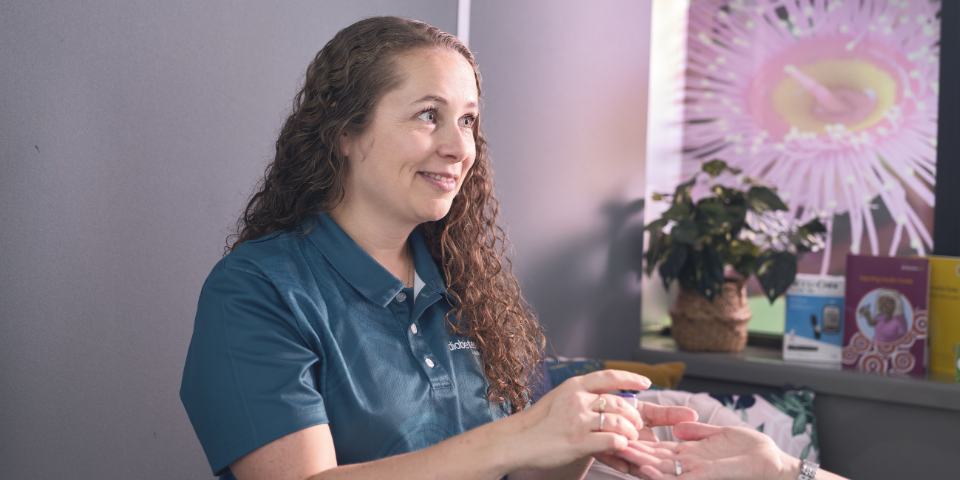
Many of the people Dr Charlotte Rowley meets have lived with diabetes for years without ever being properly taught what it means for their bodies or their lives. They’ve been given medication, told what to do, and sent on their way.
Charlotte’s work is about filling that gap – helping them understand their condition so they can take the lead in their own care. And that means engaging with people from all walks of life. It’s a confidence she developed as a member of the Murdoch University community.
Murdoch was an incredibly diverse campus. I was exposed to cultures, beliefs and ways of living that I hadn’t had much exposure to before.
Those conversations stayed with her. Not as abstract lessons, but as everyday practice that she carries with her as a diabetes educator and dietitian with Diabetes WA.
“It taught me that there’s no one right way to think about anything,” Charlotte said.
“Now, when I’m working with clients, I’m not trying to convince them to see things my way. I’m trying to understand where they’re coming from.”
That grounding has prepared her to walk into almost any room – from regional health centres to community festivals – and start a conversation.
“Just because best practice says one thing doesn’t mean it works for someone’s life,” she said. “My job is to help people live the life they want to live, not force them into a system.”
It’s an approach shaped as much by the people she learned alongside at Murdoch as the science itself – and one that now underpins every conversation she has.
Sometimes that means telehealth appointments. Sometimes it means travelling to places like Karratha to work in Aboriginal medical services. Almost always, it means helping people make sense of what is happening inside their own bodies.
“That’s the wonderful thing about my job,” Charlotte said. “People will give you that feedback straight away. They stay behind just to say thank you – because they finally understand what’s going on.”
Charlotte’s path into health wasn’t a straight line. At school, she knew she loved biology and understanding the world around her, but she wasn’t sure what that would look like in practice.
She chose Murdoch University for its flexibility and breadth at a time when she was still working out where her curiosity might lead.
It was an environment she said didn’t force her into a single track, allowing her to explore biology, biomedical science and units beyond her core degree.
Murdoch was very good at not pigeon‑holing you.
Charlotte began her studies in environmental biology before moving into molecular biology and biomedical science.
“I wanted to know how the body worked,” she said. “I knew that if I understood that, I could help people – I just didn’t know how yet.”
That clarity came through nutrition. As part of her undergraduate studies, Charlotte took nutritional units that she wasn’t even required to complete but could access because of Murdoch’s flexibility.
“That was the point where I realised I could help people understand their bodies through something they do every day – food,” she said.
“If I hadn’t been able to take those nutrition units, I wouldn’t be doing what I do now.”
She originally chose Murdoch not because of prestige, but because of culture.
“You can get an education anywhere,” she said “What mattered to me was the culture, making connections, being part of a community.”
Within weeks, she had found a friendship group that would grow with her over the years. She became involved in mentoring, student leadership, and campus life.
After completing her undergraduate degree, Charlotte went on to complete a Masters in Dietetics and diabetes education, before returning to Murdoch to undertake a PhD through the Australian National Phenome Centre.
She had always wanted to complete a PhD and succeeded, contributing new knowledge in food chemistry and personalised nutrition.
“To me, that felt like contributing something meaningful to science,” she said.
What surprised her was that the deepest sense of impact didn’t come from this educational pinnacle. It was where it had always been – in her work.
There’s nothing as rewarding as my work with communities. You get that instant feedback. You know you’re making a difference.
It’s the woman who returns after three years because, as she put it, “I knew I could trust you.” The client who travels across the city just for an hour‑long appointment. Someone who calls back because they finally feel understood.
“When people choose to keep interacting with you, that tells you you’re doing something right.”
For students considering a career that cares, her advice is practical and honest: think about the kind of impact you want to have, the kind of interactions you want day‑to‑day, and how it will fit into your life as a whole.
Charlotte has found that space in health education. It’s a practice of care – one conversation, one explanation, one person at a time.
Start your career in Medical, Molecular and Forensic Sciences
Blog
The educator helping people take back control of their health
Posted on
Friday 3 July 2026
Topics