Blog
The conservationist who knows care sometimes means letting go
Holly still remembers the moment the crate door opened.
After months of care, preparation and quiet anticipation, the orangutan stepped forward, paused, and then climbed into the canopy with a confidence that came from years of careful preparation.
"It was overwhelming," Holly said. "You're so proud. And you're also acutely aware that you've done everything you can, and now you have to put trust in the orangutan."
That moment – part relief, part grief, part hope – sits at the centre of Holly's career in wildlife conservation.
It's why she does what she does as a zoology supervisor at Perth Zoo, and why care has always been clear in her work. It's practical. It's patient. And sometimes, it means learning when to let go.
But her path to this point wasn't so clear.
At school, Holly was told more than once that a career working with wildlife and undertaking a science degree might not be realistic. Her academic performance didn't fit the narrow mould some expected and the message she received was subtle but persistent: aim lower.
But she refused. Like many students who didn't follow a traditional academic route at school, she entered Murdoch University through a preparation program – a step that proved formative rather than limiting.
"I did a preparation course to begin with," Holly said. "And I think that's really important for people to know – especially if academically they didn't apply themselves at school, or they didn't do the specific subjects needed to get straight into a degree.
"There are so many other avenues to be able to get into university."
That perseverance provided a pathway into studying wildlife biology and conservation – and changed everything.
At Murdoch University, Holly found an environment that valued curiosity as much as grades.
The pathway wasn't a compromise, it was a bridge that gave her the grounding, confidence and academic skills she needed to thrive.
Murdoch University prepared me incredibly well. Not just for the science, but for the reality of the work.
That preparation was shaped by lecturers who taught with obvious passion and conviction. One of her lecturers, Howard Gill, still stands out in her mind today.
"You could feel how much he cared – about the animals, especially fish, the ecosystems, but also about us as students," Holly said.
"It made you want to do better, because you understood why it mattered."
The course combined theory and practice to make learning tangible. Fieldwork, labs, data analysis and real‑world case studies sat alongside conversations about ethics, responsibility and impact.
"You weren't just learning about conservation, you were being prepared to step into it," Holly said.
That readiness became critical when she moved into hands‑on conservation work, both at Perth Zoo and volunteering on wildlife conservation programs overseas.
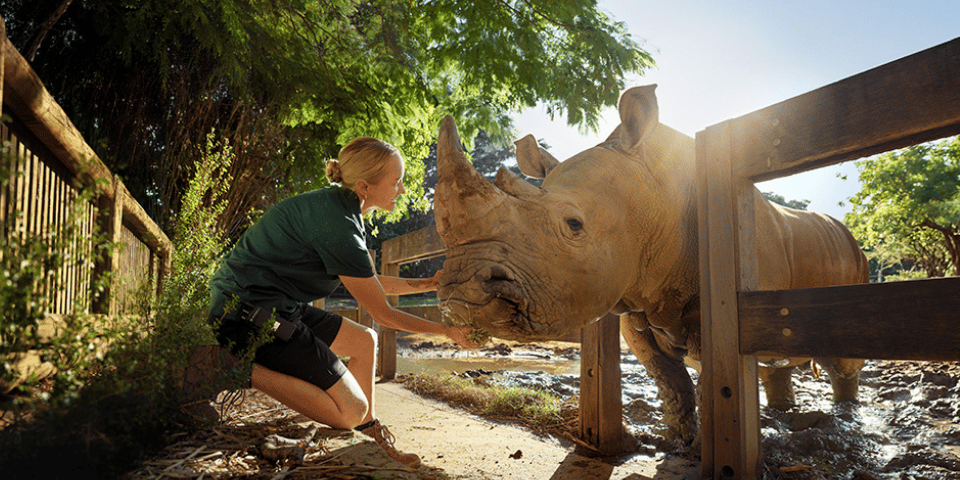
As a young conservationist, she was involved in the early establishment of the Asian Rhino Project, travelling to see Sumatran rhinos firsthand. Seeing the animals up close was transformative.
"Seeing the really important work happening for their conservation – and the communities directly working with them – was something I just fell in love with."
At the same time, she formed lasting bonds with the rhinos at Perth Zoo, where she was present for the births of Tamu and Bakari and worked closely with their father, Memphis.
However, it is the orangutan release that remains the most emotionally charged moment of her career so far – a culmination of long days, close observation and deep trust.
You invest so much care into an animal, and then you have to accept that success means not being part of their life anymore.
"But that is the wonder and beauty of it too – seeing this animal go into the wild to continue his species' preservation."
Today, the impact of Holly's work at Perth Zoo and her ongoing volunteering and consulting is both immediate and far‑reaching.
While much of her role centres on animal welfare and conservation outcomes, she also understands the quiet power of education and how a single encounter can change how someone thinks about wildlife and their responsibility to it.
"You see it when people really look, when they slow down and start asking questions."
That ripple effect matters because conservation doesn't just happen in forests or field sites. It happens in moments of connection – when someone leaves knowing a little more, caring a little deeper.
The zoo becomes not just a place of wonder, but a point of influence.
Looking back, Holly said that Murdoch University had given her legitimacy at a time when others doubted her capacity.
For students who might be hearing similar doubts now, Holly's advice is to find places that invest in you. Find educators who care enough to challenge you and push you to take opportunities. And don't confuse someone else's limited expectations with your own potential.
Holly has found many wonderful mentors along the way and she pays that support forward, backing her team, creating space for growth, and offering opportunities before people feel fully ready for them.
She knows how much that belief matters. And, like the moment she watched the orangutan disappear into the trees, she understands that care is not about holding on, but about preparing others to contribute something bigger.
Start your career in environmental and conversation sciences
Blog
The conservationist who knows care sometimes means letting go
Posted on
Thursday 28 May 2026