News
Universities face the AI test

AI is forcing universities to confront a defining question: how can they harness AI’s transformative potential without compromising learning, academic integrity and the uniquely human purpose of education?
This was the big question at the heart of the 17th General Conference of the International Association of Universities (IAU) held at Murdoch University from 3-6 November.
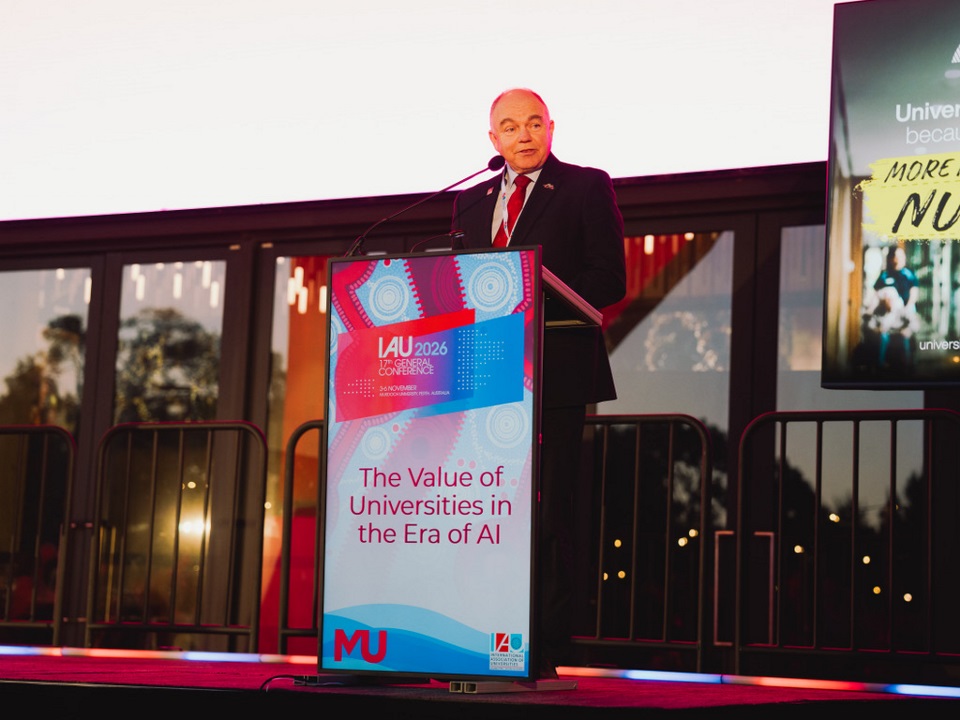
Outgoing IAU President, Murdoch Vice Chancellor and President Professor Andrew Deeks, welcomed more than 250 delegates from around the world, and spoke of the paradigm shift AI is imposing on the traditional university model.
“For the first time in history we have a technology which can interact with us, to argue and examine and to publish,” Professor Deeks said.
“If the evidence that we have relied on in the past to show that learning has happened can now be produced without the learning having happened, we have to rethink how we assess and what we believe a university education is for.”
Keynote speaker Professor George Siemens, Chief AI Transformation Officer at Southern New Hampshire University in the United States, said AI was already having a transformative effect on the way universities teach and students learn, but the results were patchy.
“We have a structural and systemic misalignment with what we offer our learners and what our learners experience in the world today,” he said.
Closing that gap will require a new approach to curriculum development, the training of academic staff, and strong governance frameworks – including decisions about how, why and when AI is integrated into classroom teaching.
Professor Siemens said the benefits of an integrated approach could include a more personalised learning experience for students, liberation from mundane planning and administration tasks to focus on student experience, and more consistency and fairness in assessments.
Performance is not learning
The conference heard AI is highly effective at handling formal, structured knowledge, making human qualities developed through experience increasingly important.
“There is a duality to AI that we don’t fully understand,” Professor Siemens said.
“People who use AI well have an increase in their performance, but when you assess and test later, they have a decrease in performance compared to others who didn’t use AI for the same task. So, we are at some levels sacrificing or offloading parts of our cognitive capability when we use it actively, but while we use it there is a decrease in overall performance.”
Studies which have looked at the effect of AI integration in classrooms found students tended to rely on AI to execute a task, rather than using AI for their own learning.
The question then is how universities can assess whether students are developing knowledge and skills that have value in the workplace and society more broadly.
“It’s a very different world and universities who have not yet started the conversation are missing out on the fundamental transformative effect of this technology,” Professor Siemens said.
“What kind of students, what kind of people do we want our learners to become?
“What is the knowledge, skills and ways of being that we expect our learners to develop so they can be successful in a world where much of what they are doing is partially or fully automated?”
Professor Siemens challenged university leaders attending the conference to consider three big questions:
What knowledge, skills and ways of being do we want learners to develop to prepare them for the emerging world of automation and AI?
How will those knowledge, skills and ways of being be taught and learned?
How will higher education create a new social and economic contract with stakeholders – including learners, faculty, society, and industry?
Other considerations are developing an institutional AI vision, philosophy and strategy; a high agency but clearly defined approach to AI adoption and use; an institutional governance model; and a determination of what AI tools the university will buy, build or share.
Universities in control
Universities also have a decision to make about how far they integrate AI into their operations – from limited functionality, such as digitising the curriculum or using AI chatbots – right through to transformative change that intentionally disconnects from legacy systems to create an “AI-first university”.
In his remarks to IAU delegates, Professor Deeks said universities needed to be clear-eyed about the use of AI in teaching, learning and research.
“These technologies are a tool – we are in control of it,” he said.
“We decide where it’s used and where it’s not. We can turn it on, and we can turn it off.
“In some settings we may want students and researchers to use it fully – in others we might deliberately choose to set it aside because the point of the exercise is human thinking itself.
“The technology does not decide the future of universities – we do.”
Watch the video address:
 |
|
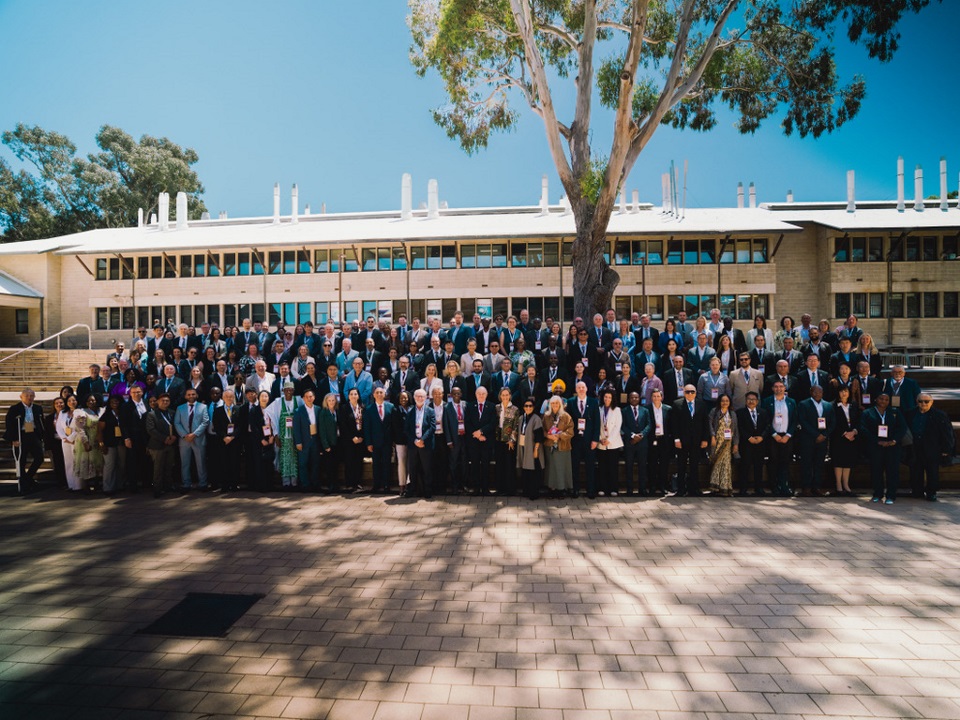
Photos: Professor Andrew Deeks, Vice Chancellor Murdoch University; General Conference of the International Association of Universities
Main article photo: Professor George Siemens
News
Universities face the AI test
Posted on