News
Study shows the factors that drive the decision to get vaccinated in Brazil

This article was originally published in The Conversation Brasil, and has been translated in English.
Authors:
Ana Rita Sequeira
https://theconversation.com/profiles/ana-rita-sequeira-340027
Marcello Antonini
https://theconversation.com/profiles/marcello-antonini-2292763
Bernardo Andretti
https://theconversation.com/profiles/bernardo-andretti-2585558
Brazil is a world leader in vaccination campaigns and public health. However, vaccination coverage rates in the country have been declining, a problem partly justified by the heated debate about vaccination. But what other factors might contribute to this? Our study, recently published in the journal Health Policy and Technology , analyzes public preferences regarding vaccine characteristics and non-pharmaceutical interventions, as well as the factors that simultaneously influence individual decision-making regarding vaccination.
Analysis of the immunization panel from the Brazilian Ministry of Health reveals a gradual decline in vaccination coverage rates since 2017. This decline varies according to the type of vaccine—such as Meningococcal C, Hepatitis B, Pentavalent, Pneumococcal, and BCG—and between regions of the country, especially the North and Northeast, which have the lowest coverage levels.
Meanwhile, data from the World Health Organization's (WHO) Immunization Portal shows the resurgence of some vaccine-preventable diseases. This phenomenon reinforces the urgency of understanding why vaccination coverage is declining in Brazil and what factors influence people's decisions to get vaccinated. This is especially important at a time when the country faces growing challenges related to political polarization, the dominant role of social media, the spread of misinformation, and the decline in vaccination coverage.
Socioeconomic, demographic and political aspects
Our work is the first discrete choice (DCE) experiment on a future respiratory pandemic (similar to COVID-19) conducted in Brazil. We brought together, in a single study, preferences regarding social restrictions imposed by the government, population preferences regarding potential vaccines against respiratory viruses, and a broad set of sociodemographic data—including moral attitudes, risk perceptions, time preferences, and political opinions.
Between July and September 2022, we gathered a sample of 3,001 Brazilian participants, carefully selected to reflect the country's demographic diversity, ensuring representativeness by age, gender, and geographic distribution. Our sample, recruited online, is composed primarily of individuals with a higher level of education than the average Brazilian population.
Participants were asked about socioeconomic, demographic, and political orientation aspects. We also presented several scenarios with different characteristics of the vaccine, as well as measures restricting movement or social interaction, as shown in the image below. In this hypothetical scenario, participants were invited to choose the option that seemed most appropriate to them between two vaccines with different characteristics, and could subsequently choose not to take either of them.
This is the first discrete choice experiment (DCE) on a future respiratory pandemic (similar to COVID-19) carried out in Brazil. It gathers, in a single study, preferences about government-imposed social restrictions, the population's preferences regarding potential vaccines against respiratory viruses, and a broad set of sociodemographic data — including moral attitudes, risk perceptions, time preferences, and political opinions.
What did we find?
Participants demonstrated high confidence in vaccines and the public health network.
Factors affecting vaccination decisions:
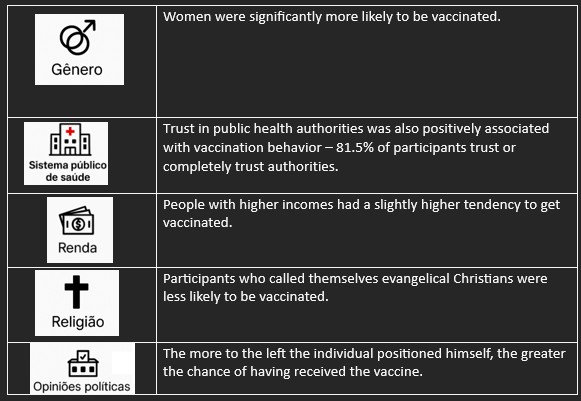
On the other hand, factors such as having a university degree, age, or region of the country did not show significant influence on vaccination decisions.
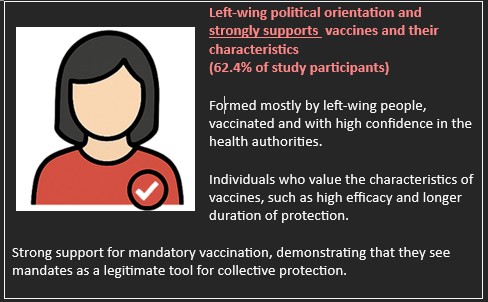
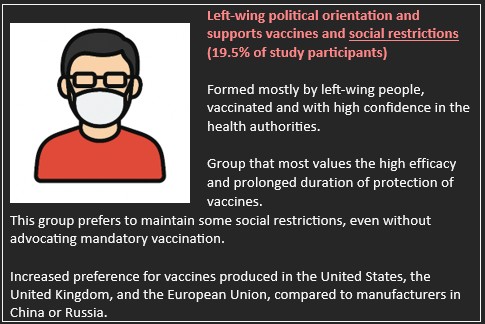
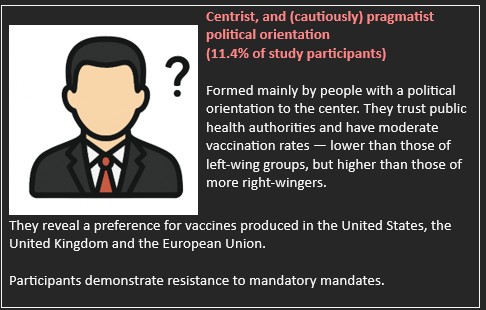
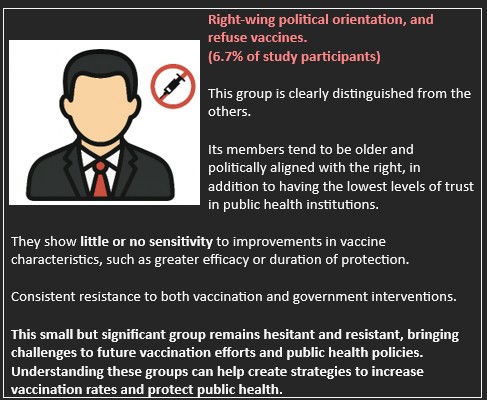
We identified four heterogeneous groups after a latent class analysis, a statistical method that groups people with similar behavior patterns, represented here by four avatars:
So what?
Our study corroborates the conclusions of other authors that political polarization is considered a crucial determinant of health, and its dynamism over time, as well demonstrated by vaccination during the pandemic and adherence to vaccination by more conservative right-wing groups.
As new health crises and epidemics emerge — which is not a matter of if, but when — it is critical that governments and health authorities rethink communication strategies aimed at vaccine-hesitant or vaccine-resistant groups.
Vaccination preferences are dynamic and can change over time. Creating dynamic systems for monitoring population preferences — such as annual vaccine sentiment surveys conducted at the state level — would allow public health decision-makers to identify changes in attitudes in real time and quickly adjust their strategies. Technology-backed approaches make public health policies more agile, inclusive, and trust-centric.
In addition, the results reinforce the importance of building and maintaining public trust in health authorities, regardless of the political orientation of the incumbent central government. Public health institutions perceived as technical, consistent, and politically independent tend to be more resilient to communication shocks and political interference, as observed during the pandemic. Strengthening this institutional trust is therefore a central component to mitigate the effects of political polarization on health behaviors.
This article is republished from The Conversation under a Creative Commons License.