News
Perth’s dolphins eat what’s in season and are loyal to their groups
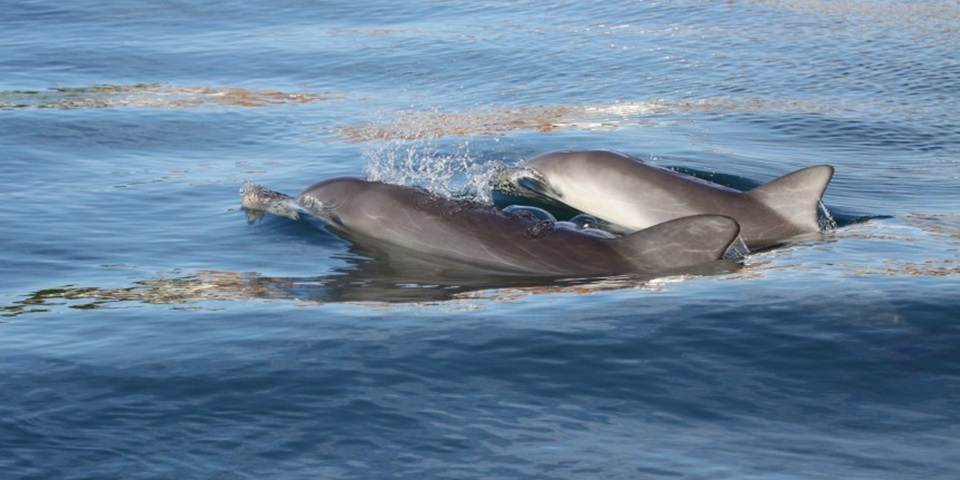
They eat seasonal food, rest half of their brain at a time, are loyal to their communities but occasionally migrate across town and are known to be able to survive shark bites.
Perth’s two dolphin groups in the Swan-Canning Rivers and further south in Cockburn Sound have been studied for more than a decade by Murdoch University researcher Dr Delphine Chabanne, who is a passionate champion of the marine mammals’ welfare.
Dr Chabanne, from Murdoch University's Harry Butler Institute, was born and raised in France and owes her name to the animal she’s been fascinated by since childhood (Delphinus is the Latin word for ‘dolphin’). She has spent her career studying dolphins and is often joined on the water by citizen scientist volunteers.
She gave a presentation to students on Perth’s coastal dolphins in late 2025 as part of Western Australian Marine Science Institution's (WAMSI) education outreach program Thinking Blue. The program connects school students with leading researchers from WAMSI’s partnership through online talks.
“There are three species of coastal dolphins in Western Australia and here in Perth the only species present is the Indo-Pacific bottlenose dolphins,” Dr Chabanne said.
“There are about 120 dolphins who live primarily in Cockburn Sound and Owen Anchorage and about 25 who use the Swan Canning estuary.”
“Sometimes dolphins from the Swan Canning estuary will be seen with Cockburn Sound dolphins, potentially mating,” Dr Chabanne said.
“While rare, movement between communities has also been observed. One example is ‘Hugs’ who was born from a resident mum in Owen Anchorage but has been spending most of her time in the lower reaches of the Swan Canning estuary since having her first calf in 2021.”
How are dolphins studied?
Dr Chabanne said dolphin surveys involved travelling by boat in either parallel lines or zig-zag to look for groups of dolphins. When they are spotted, researchers take photos, record the group composition and monitor the animals’ behaviour. Environmental conditions are also collected, when possible, such as water temperature and depth in the area.
“We photograph the dorsal fins because each one is distinctive. Dolphins are born with smooth fins, but over time individuals get nicks, scars and notches that allow us to track them.”
“Since 2011, we have been issuing a ‘Finbook’ on the River Guardians website which helps identify local dolphins residing in the Swan Canning estuary.”
She said sometimes dolphins had bigger injuries such as shark bites.
Dolphins are generally resilient to shark bites, unless they were bitten on their softer bellies where their vital internal organs are located.
Seasonal diets
Perth’s dolphins are opportunistic with food. Dr Chabanne said their preferences changed with the seasons: In summer they tended to eat more benthic detritivore fish, such as mullet, while in winter they prefer cuttlefish and octopus. Although dolphins have teeth, they often toss octopus into the air to break it into smaller pieces before swallowing it.
Threats to dolphins
“One of the biggest dangers is fishing lines and nets in the water that can tangle dolphins,” Dr Chabanne said.
“Removing the gear can be very difficult, and because of their size, thinner blubber, and their limited awareness of their environment, dolphin calves are particularly vulnerable to fishing gear entanglement.”
She said boat strikes were another threat to the mammals and because they relied on sound, loud noises underwater can disturb their behaviour.
Keeping the waterways clean and free of pollution was also important for their overall health.
“Cetacean Morbillivirus, which weakens the animals’ immune system, has killed dolphins around Perth. Some of six dolphins found dead in 2009 were infected with the virus, and another five died in 2019.”
Interesting dolphin facts
Females can live for about 40 years, while males live around 35 years.
They emit clicking sounds and listen to the returning echoes as sound waves bounce off surfaces to understand their surroundings and search for food.
Dolphin pregnancy lasts 12 months, with calves staying with their mothers for 3 to 5 years as they learn essential skills.
Dolphins rest one half of their brain at a time, allowing them to stay alert for predators or danger and to surface for air.
How to protect dolphins?
- Keep the oceans/estuaries/coast clean and tidy.
- Have a beach clean up to stop rubbish going into the water.
- Carefully dispose of fishing line and other gear
- Slow down in boats
- Don’t feed dolphins
- Join a citizen science program
Find out more about the Harry Butler Institutes' Centre for Sustainable Aquatic Ecosystems at Murdoch University.
This article was authored by WAMSI and is reproduced with permission. Photo courtesy of WAMSI.
News
Perth’s dolphins eat what’s in season and are loyal to their groups
Posted on
Harry Butler Institute (HBI)
As experts in the area of sustainable development, the Harry Butler Institute enables industry to deliver maximum economic value to our community, whilst simultaneously safeguarding the environment.