News
Indigenuity at the forefront of new Murdoch-Haskell collaboration
.tmb-960-banner.jpg?Culture=en&sfvrsn=11d8b2ba_1)
Murdoch University and Haskell Indian Nations University are launching a new partnership to explore how Indigenuity can help shape more sustainable, connected, and resilient futures through research, education and community-driven collaboration.
Indigenuity – Indigenous ingenuity – is a guiding framework which reflects a world view of reciprocity with land, water, air, and all living beings, recognising humans as part of the natural world.
The framework suggests that growing disconnection from these relationships has created an "insulated ignorance" that limits humanity's capacity to address complex environmental challenges.
Delivered through Murdoch University's Office of Global Engagement, this initiative aims to foster respectful collaboration on Indigenous-led approaches to climate action, health, education and entrepreneurship, grounded in the strength of Indigenous knowledge systems.
At the heart of the project is collaboration with renowned scholar Professor Daniel Wildcat, from Haskell Indian Nations University.
Professor Wildcat, a Yuchi member of the Muscogee Nation of Oklahoma, has spent nearly 40 years studying the intersection of Indigenous knowledges with technology, the environment, and education.

“By drawing on Indigenous Knowledges, Indigenuity offers a framework for reimagining our relationship with the planet and shaping more sustainable futures,” Professor Wildcat said.
“What ties Indigenous peoples together is a deeply ecological kinship view of the world, where we don't see ourselves as separate from the balance of life.
We are of the Earth; we honour the Earth – this is our mother. We honour the land, the air, the water, the plants, and animals around us, everything is related and entangled.
This month, Professor Wildcat was invited to Murdoch University’s Perth campus where he visited academics and students at the Harry Butler Institute, the Ngangk Yira Institute for Change, the Murdoch Business School, and the School of Media & Communication.
During his visit, Professor Wildcat also travelled to Shark Bay to meet Murdoch University Professor of Practice Michael Wear, recipient of the inaugural Prime Minister's Prize for Aboriginal and Torres Strait Islander Knowledge Systems.
Professor Wear welcomed Professor Wildcat and others to Malgana country, where his company, Tidal Moon, is working to restore 100 hectares of seagrass through a landmark two-way science collaboration with Murdoch University Pro Vice Chancellor, College of Environmental and Life Sciences Professor Jennifer Verduin.
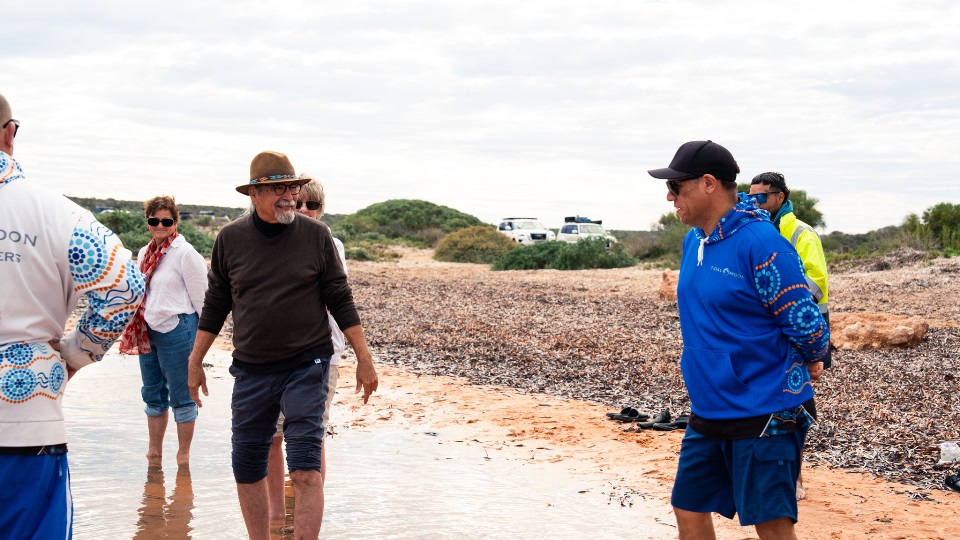
The visit highlighted how Indigenous-led knowledge and practice are already informing innovative environmental initiatives in Western Australia.
“As a custodian, you’ve got to look after country,” Professor Wear said.
It goes back to entanglement, or as I say it, my dreaming.
“The space between everything, you’ve got to make sure that space is always healthy, you’ve got to make sure you look after that space, and then you bring people in to help you on that journey.
Partnership goals include:
- Advancing community-led approaches to climate change adaptation and mitigation in partnership with the Rising Voices Changing Coasts Convergence Science Hub at Haskell.
- Supporting behavioural health initiatives for expectant mothers, young mothers and children through the Ngangk Yira Institute for Change.
- Strengthening the integration of Indigenous knowledge systems within environmental science research and education.
- Creating opportunities for intercultural and intertribal exchanges, with a focus on Indigenous science and Indigenuity.
- Developing international Indigenous business and entrepreneurship curriculum to support Indigenous trade and economic development.
- Engaging young people through curriculum development and school partnerships, including through the Harry Butler Science Centre education program.
Murdoch University Deputy Vice Chancellor Global Engagement Professor Simon McKirdy said the partnership reflected the University's commitment to working alongside Indigenous communities and knowledge holders to address some of the world's most pressing challenges.
“Indigenous knowledge systems offer powerful insights into how we can better understand our relationship with the natural world and our responsibility to future generations,” Professor McKirdy said.
This collaboration with Haskell Indian Nations University provides a unique opportunity to bring together Indigenous Knowledges from different parts of the world, fostering meaningful dialogue, strengthening global connections, and creating new pathways for research, education and community impact.
“By learning from one another and working in partnership, we can support innovative approaches to sustainability and help build more resilient futures for communities locally, nationally and internationally.”
News
Indigenuity at the forefront of new Murdoch-Haskell collaboration
Posted on