News
Faster, more accurate newborn sepsis test in development
Testing newborn babies for sepsis could become faster and more accurate, reducing complications and deaths, thanks to the development of a WA-led point-of-care neonatal sepsis test.
Murdoch University Professor Andrew Currie, who is leading the project in partnership with Child and Adolescent Health Service’s Clinical Professor Tobias Strunk at King Edward Memorial Hospital Neonatology Services, said neonatal sepsis contributes to significant morbidity and mortality annually in Australia.
“Neonatal sepsis is a critical global health challenge demanding urgent attention in Australia, especially in remote locations where delayed diagnoses are experienced,” Professor Currie said.
“Existing early diagnostic blood tests are limited and require time-consuming hospital-based analysis rarely found outside tertiary hospitals, particularly in low to middle income countries.
“Delayed or incorrect diagnosis increases mortality risk, long-term adverse outcomes and inappropriate antibiotic use.”
Thanks to support from Channel 7 Telethon Trust, Future Health Research and Innovation Fund, and National Health Medical Research Council (NHMRC), Professor Currie and his team are developing PreSep-4, a rapid point-of-care blood test for neonatal sepsis.
PreSep-4 is compatible with cutting-edge Australian lateral flow assay (LFA) detection technology.
The test’s four biomarkers achieve over 95% accuracy in diagnosing neonatal sepsis at the first suspicion of sepsis, up from the current 60% accuracy rate, and won’t require any specialist equipment to perform.
The biomarkers used are key molecules in the sepsis pathway, identified through advanced proteomics and a machine-learning-based diagnostic selection pipeline. These were discovered in WA newborns enrolled in the international PROTECT trial led by Professor Strunk.
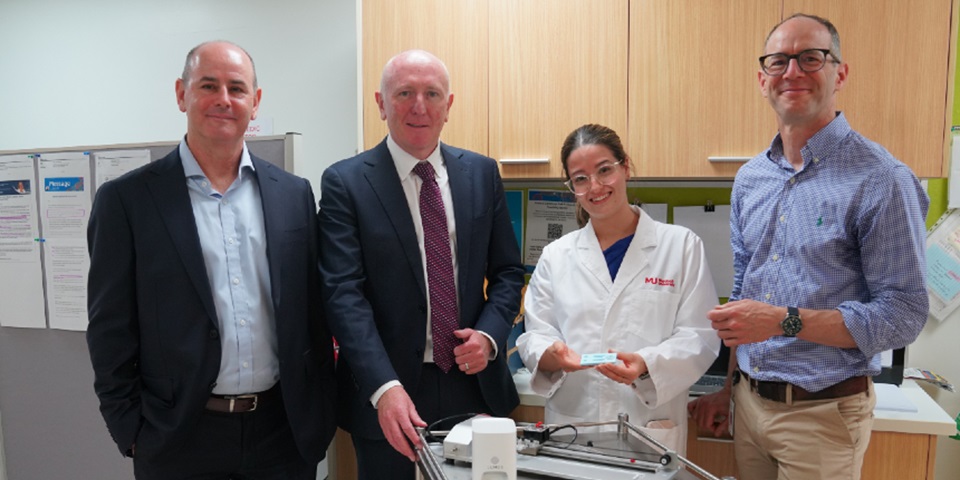
“ALFRD, which we received thanks to Telethon, allows us to precisely stripe small volumes of antibodies onto our diagnostic device and make many copies for evaluation,” Professor Currie said.
“We are currently in the early prototype development phase, with formal analytical and clinical validation still ahead of us.
“The pace of progress is heavily dependent on securing sustained funding before the product is ready for clinical deployment globally.
“Once optimised, the plan is to evaluate the use of PreSep-4 initially in the NICU at King Edward Memorial Hospital, with plans for a broader rollout with our international clinical partners.
“We are thankful to Telethon and the WA Government for their amazing support, which has allowed us to prioritise the health of the smallest and most precious members of our community.”
The project team is partnering with Biotome Pty Ltd, a Perth-based diagnostics start-up experienced in diagnostic test development.
“This is what the Cook Government’s Future Health Research and Innovation fund is all about. Working with Telethon, we’re supporting work that can change lives,” Minister for Medical Research Stephen Dawson said.
“Few things matter more than giving every child the healthiest possible start to life. By investing in this research, we are supporting the discoveries and treatments that could make a life-changing difference for babies, families and communities across Western Australia."
Image: Professor Andrew Currie, the Hon Stephen Dawson Minister for Science and Innovation; Medical Research, Dr Breanna Knight and Clinical Professor Tobias Strunk.
News
Faster, more accurate newborn sepsis test in development
Posted on