News
Australian fertiliser vulnerability exposed as researchers race to reduce nitrogen dependence
Ongoing conflict in the Middle East has laid bare a critical weakness in Australia's agricultural supply chain, with urea fertiliser prices surging by as much as 50% over the past fortnight.
Since February, shipping through the Strait of Hormuz, through which roughly one-third of the world's seaborne fertiliser trade passes, has collapsed.
A reported one million tonnes of fertiliser is currently stranded in the Persian Gulf, and Australia holds no large-scale strategic reserves. Additionally, widespread infrastructure damage in the region means that even if the Strait reopened tomorrow, supply will be constrained for months.
It is against this backdrop that a research project led by Murdoch University's Centre for Crop and Food Innovation (CCFI), in collaboration with Australian Grain Technologies, The University of Western Australia, Curtin University and the WA Department of Primary Industries and Regional Development, is working to reduce fertiliser dependency for one of the nation's most important export crops: wheat.
The Wheat Nitrogen Use Efficiency (NUE) project, supported by the Grains Research and Development Corporation (GRDC) and the WA Agricultural Research Collaboration (WAARC), is identifying the genetic mechanisms that allow wheat varieties to convert applied nitrogen into yield and grain protein more effectively.
Currently, wheat crops account for less than 40% of applied nitrogen, with only 33% recovered in the grain and the rest lost to the environment.
If researchers can shift those numbers through improved genetics, growers could maintain or increase yields while using significantly less fertiliser, cutting input costs and reducing exposure to the kind of supply chain shocks now playing out in real time.
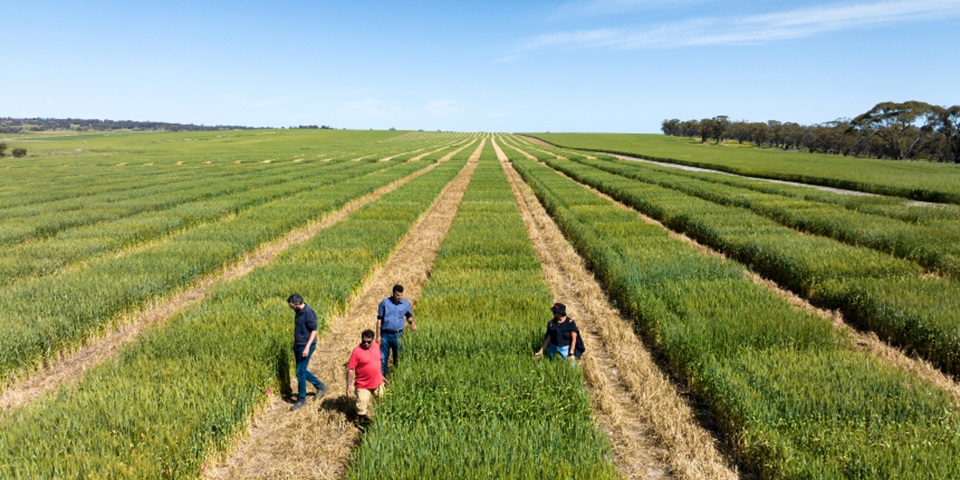
The team has identified genetic regions that contribute to nitrogen use efficiency, grain protein content and yield. Wheat lines carrying the best-performing combinations of these genetic regions are being tested across diverse Australian field environments spanning different rainfall zones, soil types and nitrogen treatments.
Multi-location, multi-year field evaluation data may also identify wheat lines that outperform both commercial checks and parental varieties for grain protein and yield across multiple locations.
Last week, all project partners and collaborators, along with GRDC and WAARC senior leadership teams, held a strategy meeting at UWA to review initial findings and plan multi-location field trials, glasshouse and laboratory work to fast-track project deliverables.

Photo: Wheat Nitrogen Use Efficiency team at UWA
In a statement, Wheat NUE Project leader and CCFI Director Professor Rajeev Varshney said:
"What this conflict has shown us is that nitrogen use efficiency is no longer just a research priority; it is a national imperative. Enhancing NUE maximises yield, grain protein, and grower profitability, whilst limiting the environmental impact of wheat production. Critically, it also insulates Australian agriculture against global supply chain shocks that we simply cannot control."
Highlighting the role of the project, particularly in the context of Western Australia, WAARC Director Dr Kelly Pearce said:
“Through WAARC’s partnership in this project, we are ensuring that cutting-edge genomics and breeding innovations are translated into practical solutions for WA growers, helping safeguard productivity, sustainability, and the competitiveness of our grain industry into the future.”
Murdoch University Food Futures Institute Pro Vice-Chancellor, Professor Peter Davies, added:
“Murdoch University researchers and collaborators are at the forefront of building genuine resilience against global market volatility that we’ve had to navigate in recent years.
We’re eager to build on initial findings and deliver critical genomics resources to wheat breeders, so that new and improved varieties can be developed and delivered into the hands of Australian farmers as quickly as possible.”
About the Wheat NUE Project
The five-year Wheat Nitrogen Use Efficiency project was established in 2024 and will run through to March 2029. Murdoch University’s Centre for Crop and Food Innovation (CCFI) is leading the research in collaboration with The University of Western Australia (UWA), the Department of Primary Industries and Regional Development (DPIRD), Curtin University, and plant-breeding company Australian Grain Technologies (AGT). The initiative has investment from the Grains Research and Development Corporation (GRDC) and WAARC, including its six members: DPIRD, CSIRO, Grower Group Alliance, Curtin University, Murdoch University and UWA.
News
Australian fertiliser vulnerability exposed as researchers race to reduce nitrogen dependence
Posted on